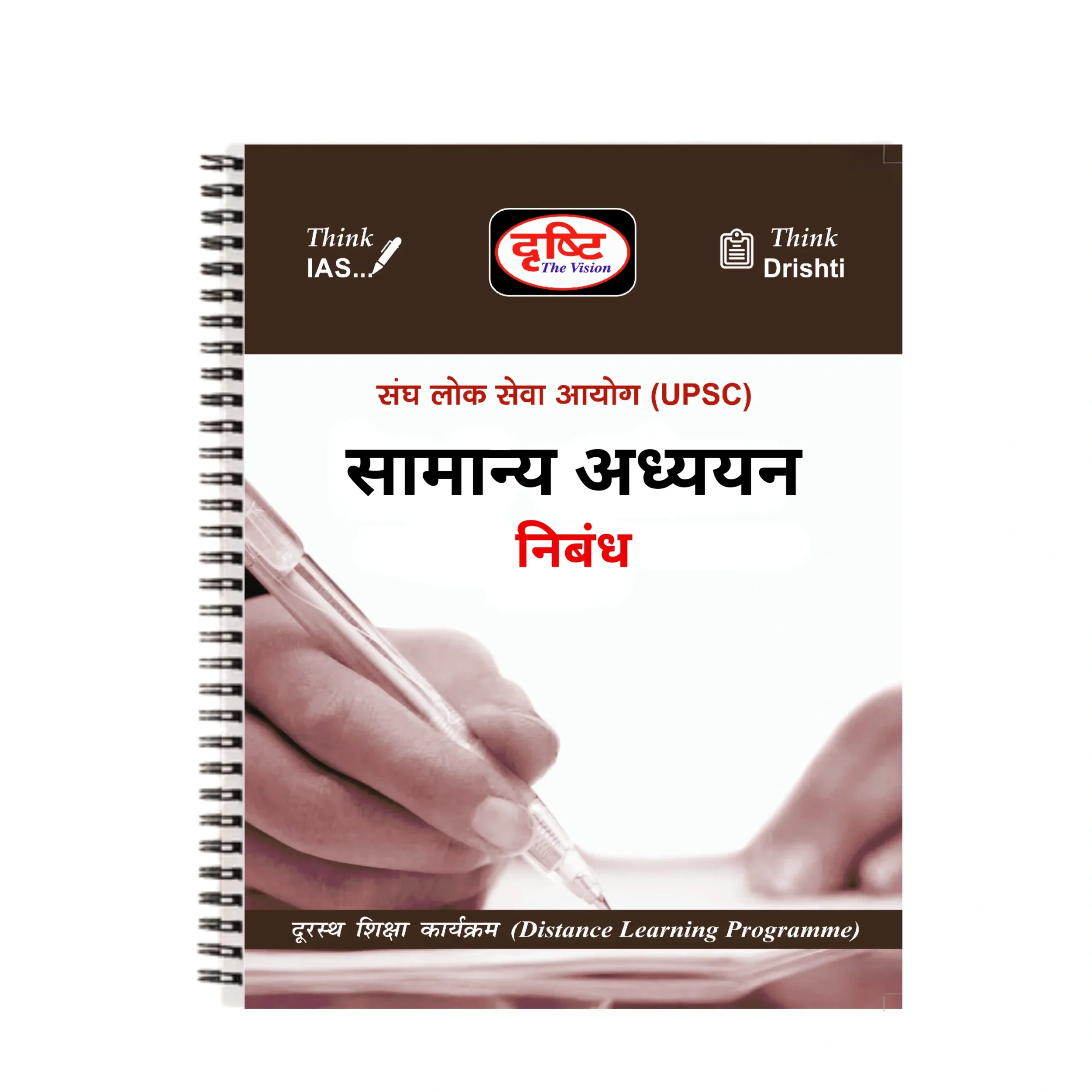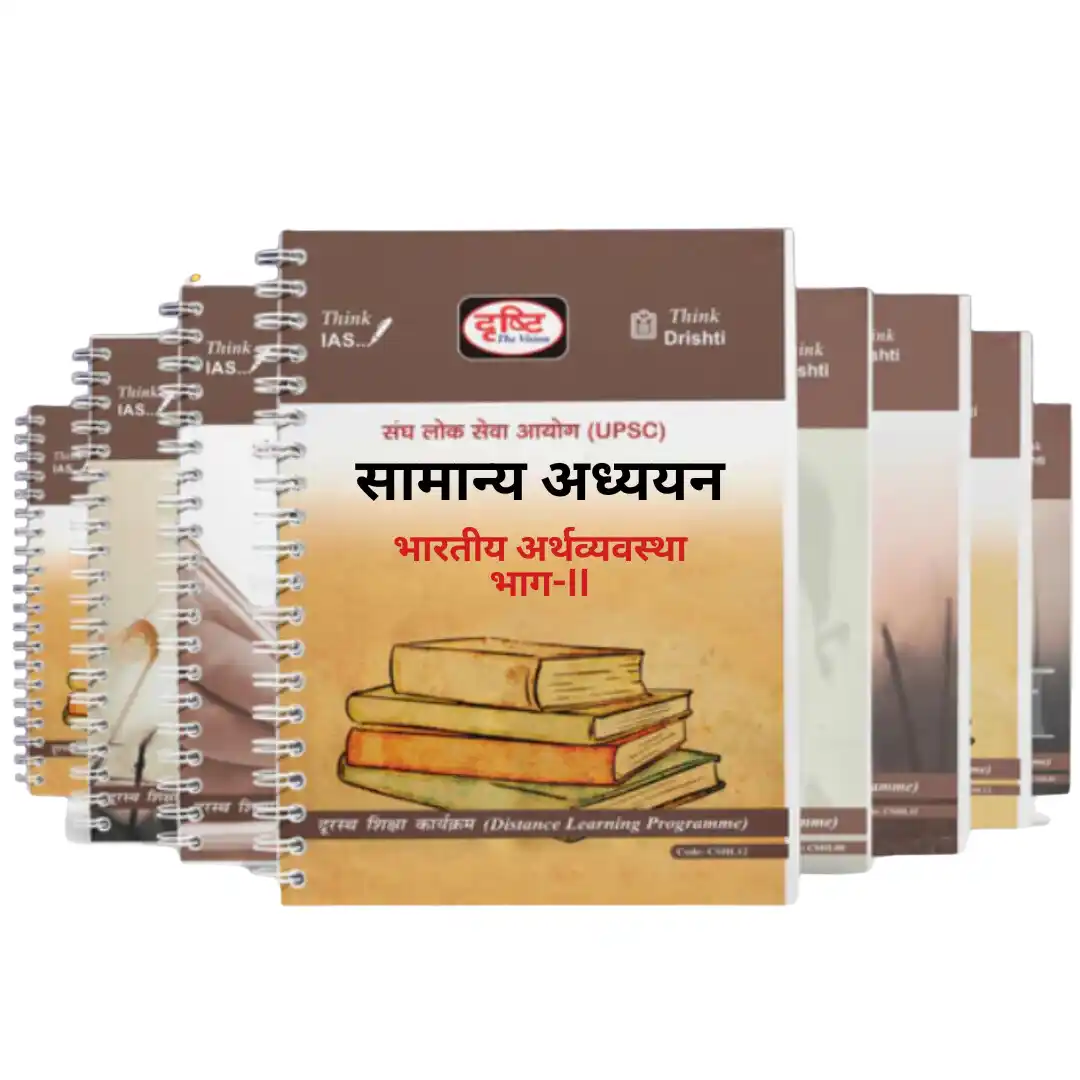

Drishti IAS English 2025 | The Definitive UPSC Civil Services Study Material & Comprehensive GS Notes Set
Product Overview
| Feature | Specification Details |
|---|---|
| Booklets Count | Full Comprehensive Set (32 Specialized Booklets) |
| Language | English Medium (Standard Academic Proficiency) |
| Publisher | Drishti Publications (Drishti IAS - New Delhi) |
| Condition | Brand New (2025 Edition - Latest Print) |
| Format | Printed Paperback / High-Quality Spiral Bound (Select Subjects) |
Complete Booklet Catalog
This exhaustive 2025 compilation from Drishti IAS is meticulously organized into thematic modules to cover the entirety of the UPSC Civil Services Examination (CSE) Syllabus for General Studies (GS) Paper I, II, III, and IV, along with dedicated CSAT modules. Below is the detailed inventory of the booklets included in this shipment:
- Booklet 1: Ancient Indian History (Pre-historic to Post-Gupta)
- Booklet 2: Medieval Indian History (Delhi Sultanate to Mughal Empire)
- Booklet 3: Modern Indian History (Advent of Europeans to 1857)
- Booklet 4: Indian National Movement (Freedom Struggle & Independence)
- Booklet 5: Art and Culture (Visual Arts, Performing Arts, & Literature)
- Booklet 6: Physical Geography (Geomorphology, Climatology, Oceanography)
- Booklet 7: Indian Geography (Physical and Human)
- Booklet 8: World Geography (Continental Deep-dives and Mapping)
- Booklet 9: Indian Polity & Constitution (Foundations & Executive)
- Booklet 10: Indian Governance & Administration (Institutional Frameworks)
- Booklet 11: Panchayati Raj & Local Self-Government
- Booklet 12: Social Justice & Welfare Schemes
- Booklet 13: International Relations - Part A (India & Neighbors)
- Booklet 14: International Relations - Part B (Global Groupings & Institutions)
- Booklet 15: Indian Economy - Macroeconomics & Foundations
- Booklet 16: Indian Economy - Sectoral Analysis (Agriculture, Industry, Services)
- Booklet 17: Money, Banking, & Financial Markets
- Booklet 18: Environment & Ecology (Basics & Biodiversity)
- Booklet 19: Climate Change & Environmental Legislation
- Booklet 20: General Science (Physics, Chemistry, Biology)
- Booklet 21: Science and Technology (Space, Defense, Biotech, IT)
- Booklet 22: Internal Security (Challenges & Management)
- Booklet 23: Disaster Management (Protocols & Indian Context)
- Booklet 24: Ethics, Integrity, & Aptitude - Theoretical Framework
- Booklet 25: Ethics - Philosophical Underpinnings & Thinkers
- Booklet 26: Ethics - Case Studies & Applied Aptitude
- Booklet 27: Post-Independence India
- Booklet 28: World History (Industrial Revolution to Cold War)
- Booklet 29: Indian Society & Social Issues
- Booklet 30: CSAT - Logical Reasoning & Mental Ability
- Booklet 31: CSAT - Quantitative Aptitude & Data Interpretation
- Booklet 32: CSAT - Reading Comprehension & Communication Skills
Exceptional Physical Construction & Print Quality
The 2025 Drishti IAS study material is engineered for heavy, long-term use. Recognizing that a UPSC aspirant spends thousands of hours with these materials, we have ensured the physical attributes exceed standard publishing benchmarks.
Paper Specification: 75 GSM Ivory Bond
Unlike standard market photocopies that use 50-60 GSM paper leading to "ink bleed-through," every page in these booklets is printed on high-grade 75 GSM paper. The ivory/off-white tint is specifically chosen as it is "anti-glare." This reduces eye strain during late-night study sessions under LED or fluorescent lights. The paper is thick enough to allow for extensive highlighting with fluorescent markers without ruining the text on the reverse side of the page.
Printing Technology: High-Definition Monochrome
We utilize industrial-grade high-definition laser printing. This ensures that the text is sharp, deep black, and does not smudge or fade over time. More importantly, the intricate maps in the Geography booklets and the flowcharts in the Economy booklets are rendered with high contrast, ensuring that even the smallest labels (such as river tributaries or economic indices) are perfectly legible.
Durability: Reinforced Binding
The booklets are bound using a specialized heat-sensitive adhesive or industrial-grade spiral coils (depending on specific subject thickness). This "Flat-Lay" design allows you to open the book completely flat on a desk without the spine cracking or pages detaching. The covers are 250 GSM laminated cardstock, providing a water-resistant barrier against accidental spills and protecting the internal content from edge-wear.
Granular Analysis: GS Paper I Booklets (History, Geography, Society)
History Module Series
The History booklets are divided into chronological and thematic segments. The Ancient History Booklet features a dedicated "Archeological Sites Map" at the end of each chapter, correlating Harappan sites with modern-day Indian states. The index includes chapters on Paleolithic sites, the Vedic transition, the rise of Mahajanapadas, and the architectural evolution of the Gupta period. The Modern History Booklet follows a strict timeline-based approach, focusing on the "Drain of Wealth" theory with data tables and a comprehensive list of all Governor-Generals and their significant legislative contributions.
Geography Module Series
The Physical Geography Booklet is a visual masterpiece. It contains over 150 hand-drawn diagrams illustrating Plate Tectonics, Atmospheric Circulation, and Ocean Currents. The Indian Geography Booklet features detailed state-wise agricultural data and the latest forest cover reports (ISFR). Each chapter ends with a "Mapping Practice" section, prompting the student to identify mountain passes, river origins, and industrial hubs on blank outlines provided within the text.
Art and Culture
This booklet is curated to simplify the vastness of Nitin Singhania-style content into Drishti's "Memory-Map" format. It includes dedicated sections on Indian Classical Dances with posture diagrams, a chronological table of Indian Architecture (from Ashokan pillars to Indo-Saracenic styles), and a special index on UNESCO World Heritage Sites in India, updated for the 2025 exam cycle.
Granular Analysis: GS Paper II Booklets (Polity, Governance, IR)
Indian Polity & Constitution
The Polity booklets are updated with the latest Constitutional Amendment Acts and landmark Supreme Court judgments up to late 2024. The content is structured with "Comparison Tables"—for instance, comparing the powers of the President vs. the Governor, or the Rajya Sabha vs. the Lok Sabha. The Governance Booklet dives deep into Citizen's Charters, e-Governance initiatives, and the role of Civil Services in a democracy, featuring flowcharts that explain the "Red Tapism" vs. "New Public Management" paradigms.
International Relations (IR)
The IR series is split into two parts to manage the sheer volume of contemporary geopolitical shifts. Part A focuses on the "Neighborhood First" policy, detailing India’s bilateral relations with Pakistan, China, Sri Lanka, and Bangladesh. Part B focuses on global bodies like the G20 (post-India presidency analysis), QUAD, BRICS+, and the UN. Each section includes a "Strategic Importance" box which provides the fodder for writing high-scoring Mains answers.
Granular Analysis: GS Paper III Booklets (Economy, Science, Environment)
Indian Economy
The Economy booklets are perhaps the most content-dense in the set. They bypass the need for external reading by integrating the Economic Survey and Budget highlights directly into the relevant chapters. Topics like GDP, Inflation, and Banking are explained through "Concept-to-Current" linkages. For example, the chapter on Banking doesn't just define NPA (Non-Performing Assets); it provides a 5-year trend analysis of Indian bank health and explains the "Twin Balance Sheet" problem with updated RBI data.
Science, Technology, and Environment
The Science and Tech Booklet focuses heavily on "Frontier Technologies." Detailed chapters on 5G/6G rollout, CRISPR-Cas9 gene editing, and India's Gaganyaan mission are included. The Environment Booklet follows the latest IPCC reports and COP28 outcomes. It contains a specialized "Bio-data" of all National Parks and Wildlife Sanctuaries, categorized by their flagship species and vegetation types.
Granular Analysis: GS Paper IV (Ethics) & CSAT
Ethics, Integrity, and Aptitude
The Ethics set is designed to build both theoretical clarity and case-study application. Booklet 24 covers the core vocabulary (Altruism, Integrity, Probity, etc.). Booklet 25 provides biographies and the ethical "Kernels" of thinkers like Socrates, Kant, Mill, and Indian philosophers like Kautilya and Swami Vivekananda. Booklet 26 contains 100+ solved case studies, ranging from corporate dilemmas to administrative crisis management, using the "Stakeholder Mapping" approach recommended by top IAS toppers.
CSAT (Aptitude)
The CSAT booklets are revamped for 2025 to reflect the increasing difficulty level of the UPSC Prelims. The Quantitative Aptitude Booklet includes "Short-Cut Methods" for Number Systems and Permutations & Combinations. The Reading Comprehension Booklet focuses on "Inference" and "Assumption" based questions, providing 500+ practice passages with detailed logical explanations for why an option is correct or incorrect.
The "Drishti Edge": Special Internal Features
What makes these booklets the "Best Study Material" is not just the content, but the presentation of information. Every booklet contains these unique pedagogical tools:
1. "Previous Year Questions" (PYQ) Integration
At the end of every chapter, there is a curated list of both Prelims and Mains questions asked from that specific topic over the last 15 years (2010-2024). This allows the student to immediately test their understanding of the chapter against the UPSC standard.
2. "Mains Value Addition" (MVA) Boxes
Scattered throughout the text are MVA boxes. These contain "Killer Facts," "Powerful Quotes," or "Statistical Data" that can be used as introductions or conclusions in Mains answer writing to fetch an extra 0.5 to 1 mark per question.
3. Conceptual Flowcharts
Instead of dense paragraphs, complex processes (like the Nitrogen Cycle in Ecology or the Legislative Process in Polity) are broken down into easy-to-memorize flowcharts. These serve as perfect revision notes in the final 30 days before the examination.
4. The "Quick-Revision" Index
Every booklet starts with a "Topic Weightage Analysis," showing how many questions have been asked from each chapter in recent years. This helps the aspirant prioritize "High-Yield" chapters during their first and second readings.
Frequently Asked Questions (FAQ)
1. Is this the 2025 Edition or a reprinted 2024 version?
This is the genuine 2025 Edition. It has been updated to include current affairs up to the end of 2024, the latest Union Budget and Economic Survey highlights, and the most recent 2024 UPSC Prelims/Mains question patterns. All data points, including forest reports and economic indices, are the most recent available versions.
2. Does this set cover the entire UPSC Prelims and Mains syllabus?
Yes. This 32-booklet set is designed as a "One-Stop Solution." It covers General Studies Paper I, II, III, and IV for Mains, and the GS + CSAT papers for Prelims. The only things not included are your specific Optional Subject and the compulsory regional language paper.
3. How is the paper quality for highlighting?
We use premium 75 GSM ivory-finish paper. This is significantly thicker and higher quality than standard newsprint or cheap photocopy paper. You can use highlighters and ink pens without worrying about the ink bleeding through to the other side of the page.
4. Are these booklets suitable for beginners?
Absolutely. Drishti IAS notes are famous for their "Base-to-Apex" approach. Every subject begins with foundational concepts (NCERT level) and gradually scales up to the advanced analytical depth required for the UPSC Mains. You do not need any prior background in these subjects to start studying.
5. Is the CSAT material updated for the recent 'tougher' trend?
Yes. Given the shift in the 2023 and 2024 CSAT papers towards more complex Number System and Logical Reasoning questions, the 2025 booklets have been completely overhauled. They now include advanced CAT-level logic and tougher comprehension passages to ensure you clear the 33% qualifying mark with ease.
6. How are Current Affairs integrated into the static subjects?
Unlike other materials that keep current affairs separate, Drishti integrates them. For example, the "Internal Security" booklet includes sections on recent drone attacks and new cyber-security policies, and the "Environment" booklet includes the results of the latest Tiger Census and Cheetah reintroduction project.
7. What is the shipping and packaging process?
We understand that these are valuable books. They are packed in a multi-layered system: first, they are shrink-wrapped in plastic to prevent moisture damage; second, they are placed in a heavy-duty corrugated box; and third, the box is edge-taped to prevent tampering during transit.
8. Can I use these notes for State PCS exams as well?
Yes. While the primary focus is UPSC, the core GS content (History, Geography, Polity, Economy) is 90% overlapping with State Services like UPPCS, BPSC, RAS, and MPPSC. These notes provide a very strong base for any top-tier competitive exam in India.
9. Are there any maps or diagrams included?
Yes, hundreds of them. Geography and History booklets are heavily mapped. International Relations uses maps to explain "String of Pearls" or "IMEC Corridor." Ethics and Governance use flowcharts to explain complex administrative hierarchies and moral frameworks.
10. How should I sequence my reading of these 32 booklets?
We recommend starting with the "Foundation Duo": Indian Polity and Modern History. Once you have a grip on these, move to Geography and Economy. Save the "Value-Added" subjects like Ethics, Internal Security, and Disaster Management for after you have completed 50% of the core subjects. CSAT should be practiced weekly alongside your GS preparation.
Invest in your UPSC journey with the most trusted name in the industry. The Drishti IAS English 2025 Study Material is more than just paper and ink; it is a meticulously crafted roadmap designed to convert your hard work into a Top Rank. With its high-quality 75 GSM paper, updated 2025 content, and student-centric layout, this is the only material you will need to master the General Studies syllabus.