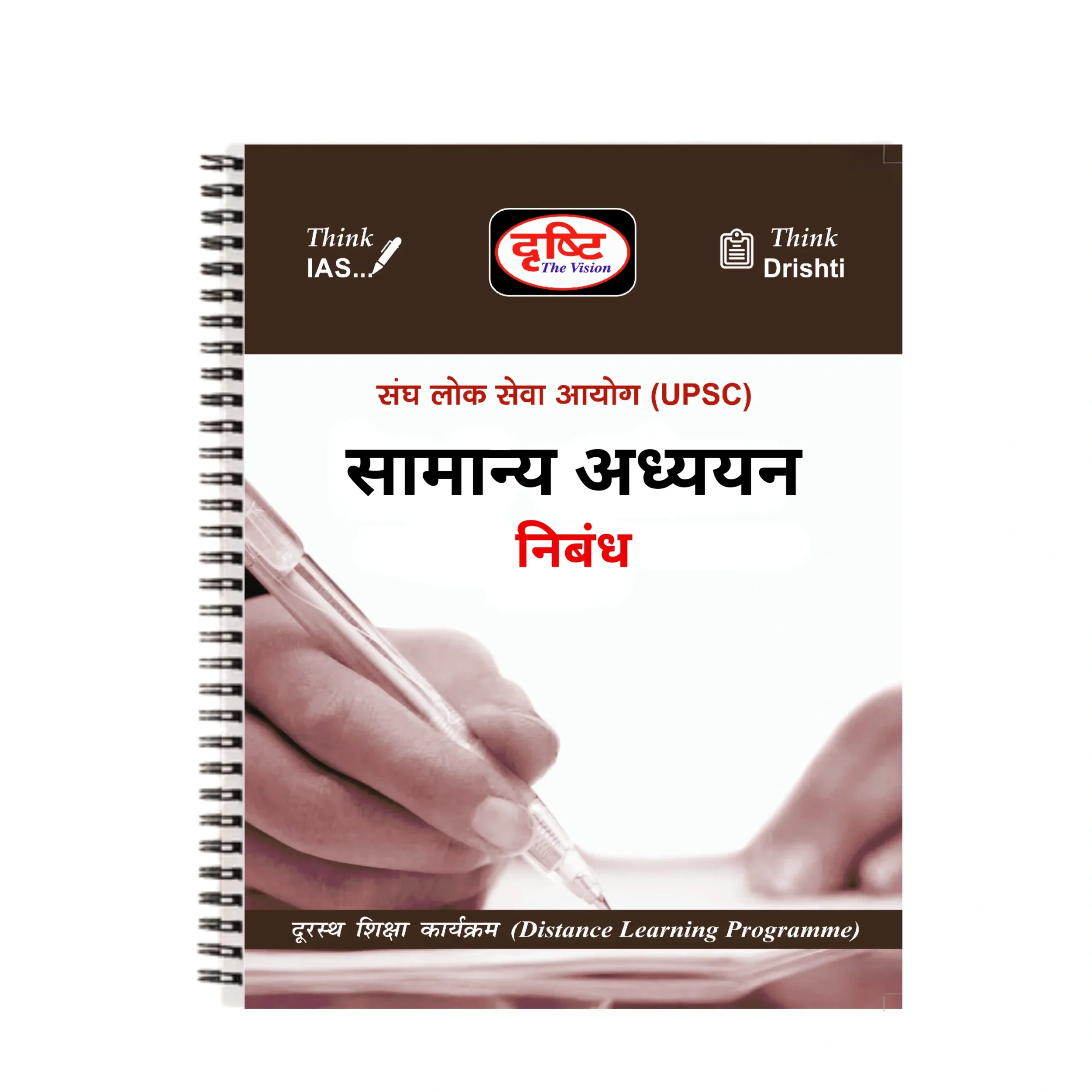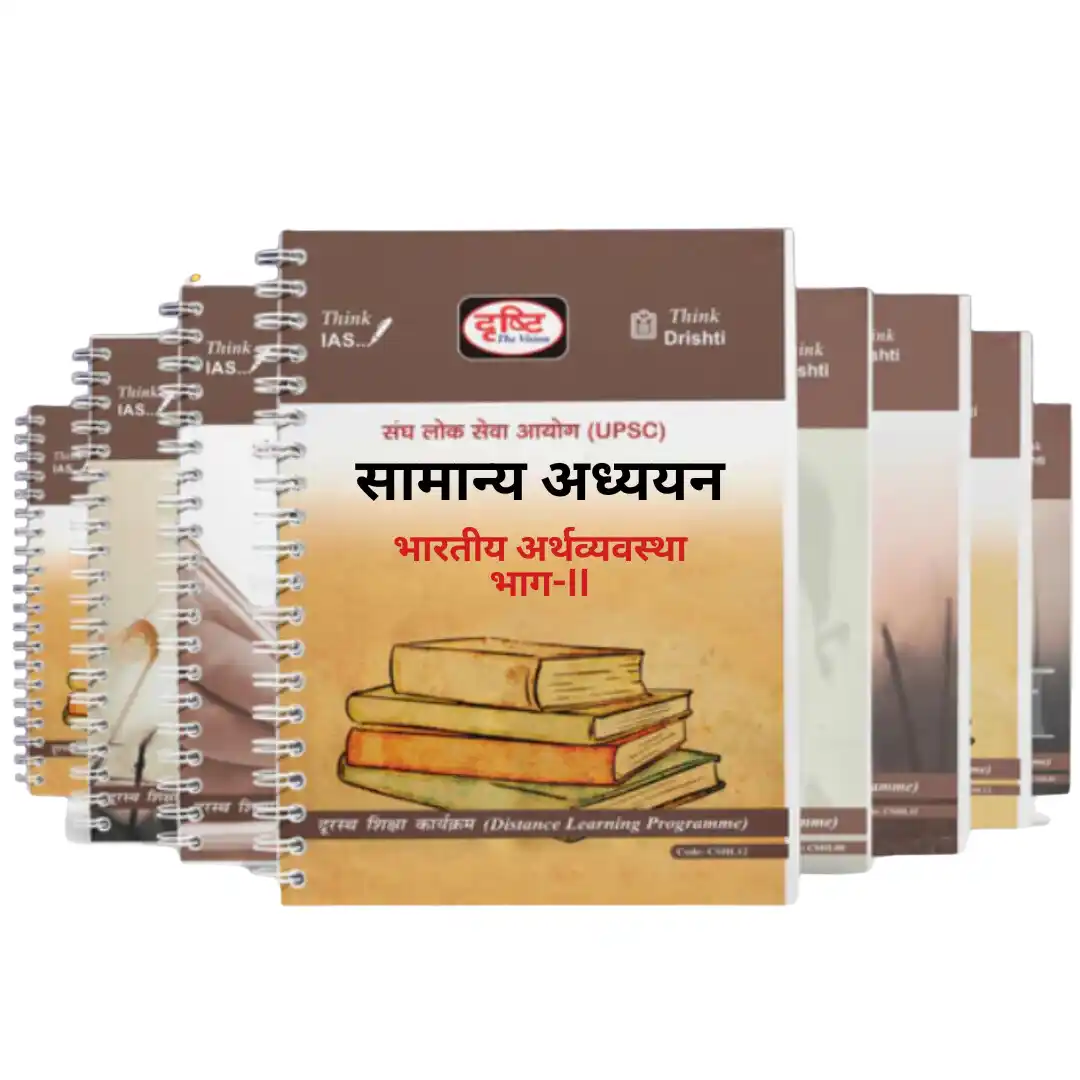

Drishti IAS Hindi Sahitya Optional Study Material: The Definitive UPSC Preparation Set (Latest Edition)
Product Overview
| Feature | Specifications |
|---|---|
| Booklets Count | 13 High-Volume Printed Booklets (Comprehensive Set) |
| Language | Hindi (Standard Academic Register) |
| Publisher | Drishti Publications / Drishti IAS (Vikas Divyakirti Sir's Curriculum) |
| Condition | Brand New (Freshly Printed/Latest Cycle) |
| Format | Printed Softcover / Spiral Bound / High-Quality Photocopy |
| Paper Grade | Premium 75 GSM High-Brightness Paper |
| Target Exam | UPSC Civil Services (Mains), State PCS (UPPSC, BPSC, RAS) |
Complete Booklet Catalog
This premium set consists of the following meticulously organized booklets, covering the entire Paper 1 and Paper 2 syllabus for the Hindi Literature Optional:
- Booklet 1: Hindi Bhasha aur Nagari Lipi ka Itihas (Section A - Paper 1)
- Booklet 2: Hindi Sahitya ka Itihas - Aadikaal, Bhaktikaal, aur Reetikaal (Section B - Paper 1)
- Booklet 3: Hindi Sahitya ka Itihas - Aadhunikaal: Bharatendu Yug se Nai Kavita tak
- Booklet 4: Hindi Gadya ka Vikas - Nibandh, Natak, aur Alochana
- Booklet 5: Kahani aur Upanyas - Detailed Analysis and History
- Booklet 6: Kavyashastra - Bhartiya Kavyashastra (Indian Poetics)
- Booklet 7: Pashchatya Kavyashastra (Western Poetics and Literary Criticism)
- Booklet 8: Vyakhya Khand - Padya (Poetry Interpretations Part 1: Kabir, Surdas, Tulsidas)
- Booklet 9: Vyakhya Khand - Padya (Poetry Interpretations Part 2: Jayasi, Bihari, Maithilisharan Gupt)
- Booklet 10: Vyakhya Khand - Padya (Poetry Interpretations Part 3: Prasad, Nirala, Pant, Mahadevi, Muktibodh, Nagarjun)
- Booklet 11: Gadya Pathyakram - Upanyas & Kahani (Godan, Maila Anchal, Divya, Mansarovar, Ek Duniya Samanantar)
- Booklet 12: Gadya Pathyakram - Natak & Nibandh (Ashadh Ka Ek Din, Bharat Durdasha, Skandgupta, Chintamani, Nibandh Nilaya)
- Booklet 13: Previous Year Solved Papers and Model Answer Writing Guide
Physical Product Architecture and Quality Standards
When investing in the Drishti IAS Hindi Sahitya notes, the physical durability of the product is as crucial as the intellectual content. Our production team ensures that these booklets are built to withstand the rigors of an intensive 12-to-18-month UPSC preparation cycle.
1. Paper Integrity (75 GSM Ultra-White)
The booklets are printed on high-grade 75 GSM (Grams per Square Meter) paper. Unlike standard 50-60 GSM paper found in cheap market reprints, this thickness ensures zero "ghosting" or "ink-bleed." This means you can use highlighters, fountain pens, or gel pens for your personal annotations without the ink seeping through to the reverse side of the page. The high-brightness factor reduces eye strain during long nocturnal study sessions, providing a crisp contrast against the black ink.
2. Print Technology and Legibility
We utilize high-resolution industrial digital printing. Every character, including the complex conjunct consonants (Sanyukt Akshar) of the Devanagari script, is rendered with razor-sharp precision. The font size is standardized at 11pt for body text and 14pt for headings, ensuring that the notes are readable even for students who prefer studying in varied lighting conditions. The ink used is smudge-proof and moisture-resistant, preventing the text from fading over time.
3. Binding and Ergonomics
Recognizing that UPSC aspirants often study in constrained spaces (like library cubicles), the booklets are bound using reinforced heavy-duty spiral binding or high-flexibility perfect binding (depending on the specific batch). This allows the booklet to lie perfectly flat on a desk, facilitating easy note-taking in the margins. The covers are protected by a 300 GSM laminated cardstock sheet, which prevents the edges from fraying and protects the inner pages from accidental spills.
Detailed Content Breakdown: Booklet 1 (Hindi Bhasha aur Nagari Lipi)
Booklet 1 focuses exclusively on Section A of Paper 1. The physical layout of this booklet is highly technical, reflecting the linguistic nature of the subject.
Internal Structure and Indices
The booklet begins with a 4-page detailed index that maps every sub-topic to specific UPSC previous year questions. The content is divided into chronological segments:
- Apabhramsa, Avahatta, and Early Hindi: Includes detailed phonetic charts and grammatical comparison tables.
- Evolution of Devanagari: Features visual representations of script evolution, showing how characters changed from Brahmi to modern Devanagari.
- Standardization of Hindi: Documents the official rules of the Government of India regarding Hindi spellings and grammar.
Each chapter in this booklet concludes with a "Drishti Special Box," which summarizes the most important linguistic definitions for quick revision. The margins are widened to 1.5 inches to allow students to add their own mnemonic devices.
Deep Dive: History of Hindi Literature (Booklets 2 & 3)
These booklets are the backbone of the Hindi Literature optional. They cover the historiography of the language from the 10th century to the modern era.
Layout and Presentation
The text is not presented in dense, unbroken paragraphs. Instead, Drishti IAS utilizes a "Bullet-Point Hierarchy" system. For example, when discussing the characteristics of 'Bhaktikaal,' the notes use sub-headings like 'Socio-Cultural Background,' 'Major Poets,' and 'Linguistic Features.'
Critical Perspectives
A unique feature of these booklets is the inclusion of "Scholar Quotes" (Alochak ke Kathan). Within the text, you will find shaded boxes containing significant quotes from Acharya Ramchandra Shukla, Dr. Nagendra, and Hazari Prasad Dwivedi. These are strategically placed to help students memorize them for inclusion in their answers, which is a key requirement for scoring 300+ marks.
Comparative Charts
Booklet 3 includes comparative charts between different eras (e.g., Chhayavad vs. Pragativad). These charts are printed in a landscape format within the portrait pages to maximize the information density.
Technical Analysis: Poetics and Criticism (Booklets 6 & 7)
Kavyashastra is often considered the most difficult part of the syllabus. The Drishti notes simplify this through structural design.
Bhartiya Kavyashastra (Indian Poetics)
Booklet 6 utilizes flowcharts to explain complex concepts like 'Rasa Nishpatti' and 'Sadharanikaran.' Every theory, from Bharat Muni to the modern commentators, is broken down into: 1. Basic Definition, 2. Key Components, 3. Critical Analysis, and 4. Contemporary Relevance.
Pashchatya Kavyashastra (Western Poetics)
Booklet 7 deals with Plato, Aristotle, Wordsworth, Coleridge, and T.S. Eliot. To make these foreign concepts accessible, the notes provide "Terminological Equivalents" (Hindi equivalents for English literary terms). The physical layout includes a "Glossary of Terms" at the end of every chapter.
The Interpretation Modules: Booklets 8, 9, and 10
Paper 2 requires mandatory explanation (Vyakhya) of poetic verses. These booklets are designed differently from the history books.
Columnar Page Design
Each page is divided into the original verse (on the top) followed by three distinct sections:
- Sandarbh (Context): The source of the verse.
- Prasang (Theme): The specific situation of the poem.
- Vyakhya (Explanation): A word-by-word and metaphorical breakdown.
- Kavyagat Saundarya (Literary Beauty): A technical analysis of the Alankar, Chhand, and Bhasha used in the verse.
This 4-step structure is precisely what UPSC examiners look for. The notes act as a template for actual exam performance.
Detailed Analysis of Prose Texts (Booklets 11 & 12)
These booklets cover the prescribed novels, stories, and plays.
Character Mapping
For complex novels like *Godan* or *Maila Anchal*, the booklets include "Character Maps"—visual diagrams showing the relationships between characters (e.g., Hori, Dhania, Gobar). This helps in understanding the social dynamics of the plot instantly.
Thematic Mind-Maps
Instead of 50-page summaries, these booklets provide 10-page thematic analyses. For the play *Skandgupta*, the notes focus on the "Conflict between State and Individual," "Women Characters," and "Historical Accuracy vs. Imagination." Each theme is a potential 20-mark question.
"Drishti-Special" Internal Features
The physical booklets contain several "Easter eggs" designed for competitive advantage:
- Model Answer Drafting: Interspersed throughout the text are solved questions from the last 5 years of UPSC Mains.
- Keyword Highlighting: Essential academic Hindi keywords are bolded in the text, so students know which words to memorize for their answers.
- Diagrammatic Logic: Concepts like the "History of Hindi Cinema" or "Evolution of Journalism" are explained via timelines and tree diagrams.
- Revision Checklists: The final pages of each booklet contain a one-page "At a Glance" summary for last-minute revision.
Packaging and Delivery Specifications
Since this is a high-volume set (13 booklets), the packaging is engineered for safety:
- Inner Layer: Each booklet is individually poly-wrapped to prevent moisture absorption during transit.
- Middle Layer: High-density bubble wrap surrounds the entire stack.
- Outer Layer: A 5-ply corrugated cardboard box with "Fragile/Handle with Care" signage.
- Weight: The total set weighs approximately 6.5kg to 7.5kg, reflecting the massive volume of information contained within.
Frequently Asked Questions (FAQ)
1. Are these notes sufficient for the UPSC Hindi Literature Optional without any extra books?
Yes, these notes are designed to be self-contained. They cover 100% of the UPSC syllabus. While reading original texts like 'Godan' is recommended, the summaries and analytical depth provided in these booklets are enough to write high-scoring answers. All major interpretations and critiques are already included.
2. How do these printed booklets differ from the class notes taken by students in Vikas Divyakirti Sir's lectures?
These are the "Classroom Study Material" (Printed Notes) which are more comprehensive and structured than handwritten notes. They contain refined language, proper diagrams, and updated data that might be missed during rapid dictation in a live class. They serve as the foundational text upon which classroom lectures are built.
3. Is the paper quality suitable for extensive highlighting?
Absolutely. We use 75 GSM high-opacity paper. You can use standard neon highlighters or even darker markers without the ink bleeding through to the other side. The paper is also "Acid-Free," meaning it won't turn yellow over several years.
4. Are these the latest 2024-25 updated versions?
Yes, we ensure that every set dispatched is from the most recent printing cycle. This includes any minor syllabus tweaks or changes in question patterns observed in the most recent UPSC Mains examination.
5. Do the notes include tips for Hindi Answer Writing?
Yes, Booklet 13 is dedicated entirely to the art of answer writing. It includes instructions on how to introduce a question, how to integrate quotes, and how to conclude using a forward-looking perspective (Nishkarsh).
6. Is it better to buy these notes or the standard textbooks by various authors?
Standard textbooks (like those by Dr. Nagendra or Shukla Ji) are academic and very vast. These Drishti notes are "exam-centric." They filter out irrelevant academic debates and focus purely on what earns marks in the Civil Services Examination, saving you hundreds of hours of research.
7. How is the binding? Will pages fall out after repeated use?
The notes use heavy-duty spiral binding or thermal perfect binding. Both methods are designed for high-frequency usage. The spirals are made of coated metal or high-grade plastic that doesn't bend easily, ensuring the booklet stays intact even after being carried in a backpack daily.
8. Does this set include the 'Vyakaran' (Grammar) portion?
Hindi Literature Optional (UPSC) doesn't have "Vyakaran" in the school sense. It has "Linguistics" (Bhasha Vigyan). Booklet 1 covers this linguistics portion in extreme detail, including the history and development of the language and script.
9. Can I use these notes for State PCS exams like UPPCS or BPSC?
Yes. The Hindi Literature syllabus for UPPSC and BPSC is largely a subset of the UPSC syllabus. These notes cover everything required for State Services, including specific regional literary trends where applicable.
10. What is the return policy if the booklets arrive damaged?
We have a 7-day replacement guarantee. If your set is damaged during transit, or if there are missing pages or printing errors, we will replace the specific booklet or the entire set at no extra cost to you. We recommend filming an unboxing video for a seamless replacement process.
In conclusion, the Drishti IAS Hindi Sahitya Optional notes are more than just study material; they are a complete pedagogical tool. Every physical aspect—from the 75 GSM paper to the structured Devanagari typography—is engineered to facilitate deep learning. This 13-booklet set represents the pinnacle of Hindi Literature preparation for the UPSC Mains, providing both the breadth of the history and the depth of the textual analysis required to excel.