
Drishti IAS Indian Economy (Bhartiya Arthvyavastha) Hindi Medium - Comprehensive Study Material for UPSC Civil Services Examination
| Feature | Product Specifications |
|---|---|
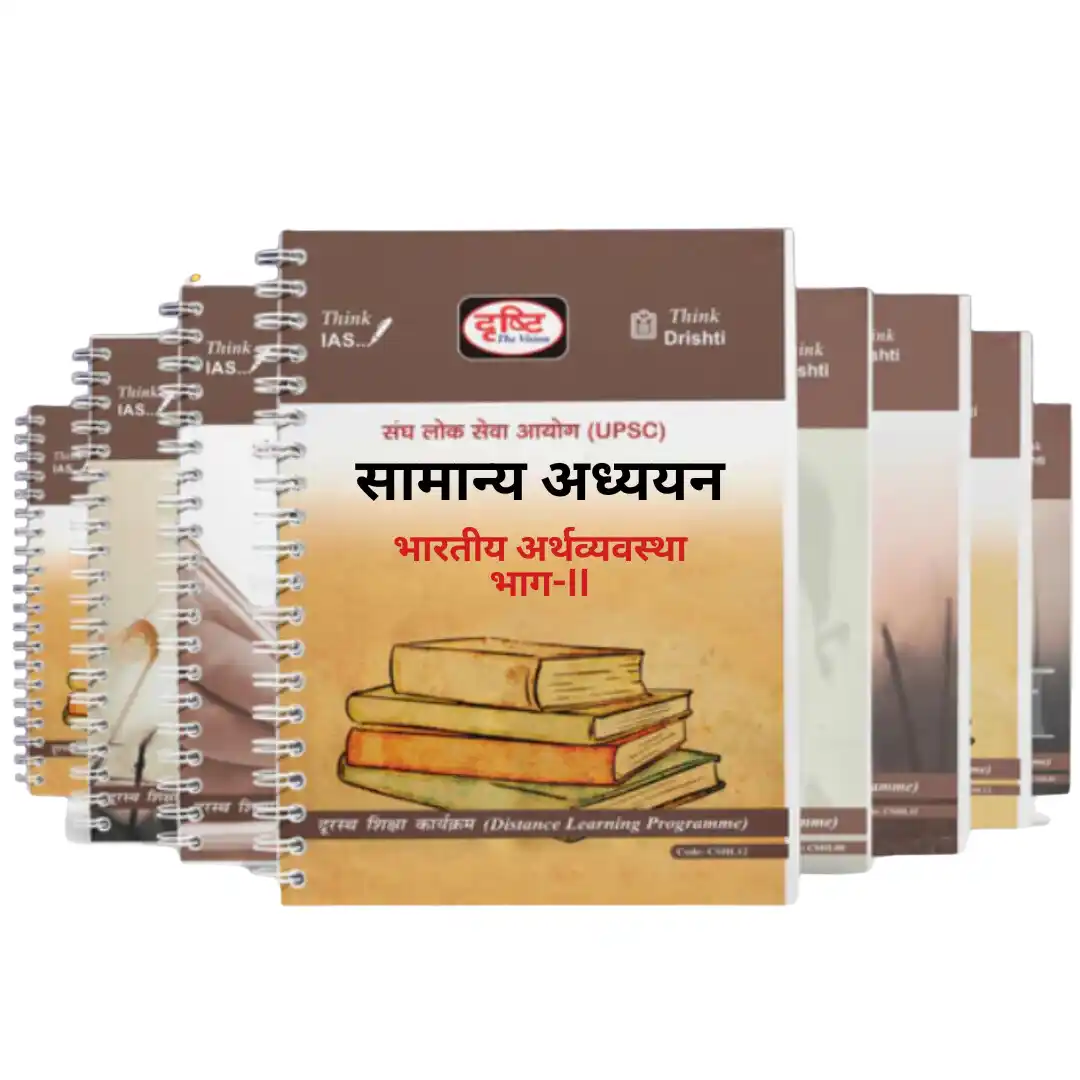
| Booklets Count | 8 Specialized Volume Booklets |
| Language | Hindi (Shuddh evam Vyavaharik Hindi) |
| Publisher | Drishti IAS (Class Notes / Distance Learning Program) |
| Condition | Brand New, Latest Edition |
| Format | High-Quality Printed Spiral/Soft Bound |
Complete Booklet Catalog
The Drishti IAS Indian Economy Hindi package is meticulously divided into the following modules, ensuring a systematic coverage of the UPSC syllabus from Prelims to Mains:
- Booklet 1: Introduction to Economics, National Income, and Economic Growth.
- Booklet 2: Money, Banking, and Financial Markets (Money Supply, RBI, Reforms).
- Booklet 3: Public Finance and Taxation (Budgeting, Fiscal Policy, GST).
- Booklet 4: Agriculture and Allied Sectors (Land Reforms, MSP, Food Processing).
- Booklet 5: Industrial Sector, Infrastructure, and Service Sector.
- Booklet 6: External Sector and International Economic Organizations (Trade, BoP, WTO, IMF).
- Booklet 7: Social Issues, Poverty, Unemployment, and Inclusive Growth.
- Booklet 8: Current Economic Developments, Union Budget Highlights, and Economic Survey Analysis.
Detailed Physical and Material Specifications
When preparing for the UPSC, the physical durability of study material is as vital as the content itself. The Drishti IAS Indian Economy series is engineered for high-intensity usage over multiple years of preparation.
Paper Quality and Print Precision
Every page in these eight booklets is printed on 75 GSM (Grams per Square Meter) high-brightness executive bond paper. This specific grade of paper is selected to ensure that ink from highlighters or gel pens does not bleed through to the reverse side—a common issue with cheaper study materials. The paper possesses an "anti-glare" matte finish, which reduces eye strain during prolonged night-time study sessions under LED or halogen lights. The text is rendered in high-definition laser print, ensuring that even the smallest subscripts in economic formulas and the finest lines in complex flowcharts are razor-sharp and legible.
Binding and Ergonomics
The booklets are bound using a reinforced soft-bind or high-tensile spiral mechanism (depending on the specific batch). The binding is designed to allow the booklets to lay perfectly flat on a study desk, which is essential for students who practice "active reading" and note-taking. The covers are protected by a 300 GSM laminated cardstock that resists moisture and prevents the edges from fraying during frequent transport in backpacks. Each booklet is light enough to be carried individually, allowing aspirants to focus on one segment of the economy at a time without lugging around a massive single-volume textbook.
In-Depth Content Breakdown of Each Booklet
Booklet 1: National Income and Fundamental Concepts
This booklet serves as the foundation. It begins with a Detailed Index that separates static concepts from dynamic trends. The internal layout includes a historical timeline of Indian economic planning, moving from the Harrod-Domar model to the NITI Aayog era.
The content focuses on the Physical Measurement of Economy. It contains dedicated chapters on GDP (Gross Domestic Product), GNP, NNP, and National Income at Factor Cost vs. Market Price. A standout feature is the "Drishti Comparison Table," which contrasts the old base year (2004-05) with the new base year (2011-12) calculations. The booklet uses visual diagrams to explain the "Circular Flow of Income" in two-sector, three-sector, and four-sector economies. Every chapter ends with a "Keywords Section" (Paribhashik Shabdavali), defining terms like 'GVA' (Gross Value Added) in simple Hindi.
Booklet 2: Money and Banking Ecosystem
The internal content of Booklet 2 is perhaps the most technical. It provides an exhaustive deep dive into the Reserve Bank of India (RBI) and the Indian Banking Structure.
The booklet is packed with Infographics illustrating the transmission of Monetary Policy. There are detailed sections on CRR, SLR, Repo Rate, Reverse Repo, and MSF. The "Vision Special" boxes explain the transition from MCLR to External Benchmarking. A significant portion of the booklet is dedicated to NPA (Non-Performing Assets) Management, covering the Insolvency and Bankruptcy Code (IBC), SARFAESI Act, and the 'Bad Bank' concept. The printing utilizes bold headers to distinguish between the various phases of Banking Sector Reforms (Narasimham Committee I & II to the current amalgamation of PSBs).
Booklet 3: Public Finance, Budgeting, and Taxation
This booklet is the "Financial Backbone" of the set. It covers the Constitutional Provisions related to the budget (Articles 112-117). The structure is highly analytical. It breaks down the 'Revenue Account' and 'Capital Account' into micro-components.
The Taxation Section is divided into Direct and Indirect taxes. The GST (Goods and Services Tax) chapter is a masterpiece of technical writing, explaining the IGST, CGST, and SGST mechanisms through numerical examples printed in easy-to-read tables. The booklet also features a 15th Finance Commission summary, detailing the vertical and horizontal devolution of funds. Physical layout includes wide margins, specifically designed for students to add the latest fiscal deficit numbers from the most recent budget.
Booklet 4: The Agrarian Economy
Given the importance of Agriculture in the UPSC Mains (GS Paper 3), this booklet is content-dense. It covers Land Reforms post-independence, the Green Revolution (Phase I and II), and the Evergreen Revolution.
Specific internal features include Mapping of Agro-Climatic Zones and detailed flowcharts of the Food Processing Industry (FPI) supply chain. The booklet provides a critical analysis of MSP (Minimum Support Price) and the role of CACP. For the first time, Driscoll notes have integrated "Technology in the Aid of Farmers" as a dedicated chapter, covering e-NAM, PM-KUSUM, and Precision Farming. The physical quality of the diagrams in this booklet—showing crop patterns and irrigation percentages—is superior, using grayscale shading to ensure clarity.
Booklet 5: Industry and Infrastructure
This booklet explores the Secondary Sector. It tracks the Industrial Policy Resolutions from 1948 to 1991 and beyond. The internal content focuses on MSMEs (Micro, Small, and Medium Enterprises) with the new 2020 definitions presented in a clear tabular format.
The Infrastructure Section covers the "National Infrastructure Pipeline" (NIP) and "PM Gati Shakti." It includes dedicated sub-sections on Energy, Ports, Roads (Bharatmala), and Railways (Sagarmala). The booklets use a "Drishti Analysis" box to discuss the "Missing Middle" in Indian industry. The print quality ensures that the complex data regarding IIP (Index of Industrial Production) and Core Industries is easily digestible.
Booklet 6: External Sector and Global Institutions
Covering India's interaction with the world, this booklet is vital for both Economy and International Relations. It details the Balance of Payments (BoP), explaining the Current and Capital accounts.
There is a profound focus on Exchange Rate Management (NEER/REER). The booklet lists every major international organization—IMF, World Bank, WTO, ADB, NDB—with their reports, functions, and India's relation to them. The WTO section is particularly detailed, explaining the various "Boxes" (Amber, Blue, Green) in Hindi, which is often a point of confusion for aspirants. The use of bullet points here makes the complex "Trade Related Intellectual Property Rights" (TRIPS) easily understandable.
Booklet 7: Poverty, Unemployment, and Social Development
This is the "Human Face" of the economy. The booklet covers Demographic Dividend and the challenges of the Indian labor market.
It includes various committee reports on poverty (Alagh, Lakdawala, Tendulkar, Rangarajan) in a chronological comparison table. The internal content discusses the Multidimensional Poverty Index (MPI) and various government schemes like MGNREGA, Skill India, and PM-Jan Dhan Yojana. The typography is designed to highlight the "Social Security" aspects, making it an excellent resource for Mains answer writing.
Booklet 8: Current Economic Updates & Survey Analysis
The final booklet is the most dynamic. It acts as a bridge between static concepts and the latest data. It contains Briefs of the Economic Survey and the Union Budget.
The physical format of this booklet often includes extra blank pages for "Self-Update." It covers the latest trends in Digital Currency (CBDC), Green Bonds, and Blue Economy. The focus is on providing the student with "Fodder Material" for Mains—statistics, quotes from the Finance Minister, and summary points of recent government white papers. It is the most frequently updated booklet in the series.
Internal Layout and Pedagogical Design
The Drishti IAS Indian Economy notes are not merely a collection of facts; they are a pedagogical tool. Each booklet follows a specific internal architecture:
- The Conceptual Map: Every chapter starts with a "Drishti Mind Map" that visually links the sub-topics, providing a birds-eye view before the deep dive.
- PyQ Integration: Previous Year Questions (Prelims and Mains) are strategically placed at the end of relevant chapters. This allows students to immediately test their understanding of the physical content they just read.
- Model Answers: For Mains preparation, the booklets provide "Model Frameworks" for complex questions, showing how to structure an intro, body, and conclusion in Hindi.
- Data Visualization: Instead of long, winding paragraphs, the notes utilize bar charts, pie charts, and trend lines to represent economic data like inflation (CPI/WPI) or FDI inflows.
Special Features for Hindi Medium Aspirants
One of the primary challenges for Hindi medium students is the availability of high-quality, standardized technical terminology. Drishti IAS solves this by:
- Standardized Terminology: Using the terms prescribed by the CSTT (Commission for Scientific and Technical Terminology), ensuring the language matches the UPSC question paper.
- Bilingual Keywords: In cases where the Hindi term is extremely complex, the English equivalent is provided in brackets (e.g., *Sakal Gharelu Utpad* [Gross Domestic Product]).
- Contextual Writing: The content is written in a flow that reflects the writing style required in the UPSC Mains Answer Sheet.
Quality Assurance and Packaging
When you order this study material, it undergoes a rigorous quality check. We ensure that:
- There are no missing pages or duplicate chapters.
- The spiral binding is smooth with no sharp edges that could damage the paper.
- The booklets are shrink-wrapped to protect them from moisture during transit.
- They are shipped in a heavy-duty corrugated box to prevent corner damage.
Why Choose Drishti IAS Indian Economy Material?
The Indian Economy is a subject where the "Source" matters more than anything. The Drishti IAS research team (Content Team) is renowned for distilling the complex "Indian Economy" by Ramesh Singh or Nitin Singhania into exam-oriented notes. By focusing on the Physical Booklets, you are investing in a resource that organizes the vast ocean of economic data into eight manageable, high-quality volumes. This material is the result of years of refinement based on the feedback of successful UPSC toppers.
Frequently Asked Questions (FAQ)
1. Is this the latest 2024-25 edition of the Drishti IAS Economy notes?
Yes, these booklets are the latest iterations provided by the Drishti IAS Distance Learning Department. They incorporate the core static concepts along with the latest data points from the most recent Union Budget and Economic Survey. We ensure that our stock is updated every quarter to reflect any major policy changes or new government schemes.
2. How does the paper quality compare to local photocopied notes found in markets like Old Rajinder Nagar?
There is a significant difference. Most local photocopies use 50-60 GSM recycled paper which is grayish and prone to ink bleeding. Our product uses 75 GSM premium white paper. The printing is high-definition laser-grade, meaning the text won't smudge if your hand is slightly damp, and the "anti-glare" properties protect your eyesight during long study hours.
3. Are these notes sufficient for both UPSC Prelims and Mains?
Absolutely. The booklets are designed with a dual-focus strategy. The factual data, tables, and "Key Facts" boxes cater to the Prelims' objective requirements. Meanwhile, the critical analysis sections, "Pros and Cons" of policies, and model answer frameworks are specifically tailored for the descriptive nature of the Mains GS Paper 3.
4. Does the package include the Economic Survey and Union Budget?
Yes, Booklet 8 is dedicated specifically to the latest Economic Survey and Union Budget highlights. While the full Survey is a thousand-page document, Drishti IAS extracts the exam-relevant "Gist," making it much easier for students to memorize and reproduce in exams.
5. I am a beginner. Is the Hindi language used in these notes very difficult?
Drishti IAS is famous for its "student-friendly" Hindi. While it uses official terminology, the explanatory text is written in a lucid, conversational style that helps in building concepts from scratch. Complex concepts like 'Sterilization of Currency' or 'Quantitative Easing' are explained with simple analogies.
6. Is the binding durable enough to last for two years?
We use high-tensile plastic or metal spirals (or reinforced glue binding) that is tested for "heavy-flip" usage. The 300 GSM cover page acts as a shield. Even with daily use, the pages are unlikely to come off. However, we recommend handling with reasonable care and keeping them away from direct liquid exposure.
7. Are there any practice questions included within the booklets?
Yes, every chapter concludes with a "Practice Zone." This includes a mix of 5-10 high-quality Multiple Choice Questions (MCQs) and 2-3 Mains-style questions. Many of these are based on the latest UPSC trends, focusing on statement-based questions and "match the following" formats.
8. How do you handle shipping and what happens if I receive a damaged booklet?
We use premium courier partners (like BlueDart, Delhivery, or DTDC) to ensure timely delivery. The booklets are packed in multi-layered bubble wrap and a rigid box. In the rare event of a printing defect (missing pages) or transit damage, we have a 7-day replacement policy where we ship the replacement booklet at no extra cost.
9. Can I use highlighters on these pages without ruining the text on the back?
Yes, the 75 GSM thickness is specifically chosen for this purpose. You can use standard neon highlighters (Luxor, Faber-Castell, etc.) or even mild markers. The ink does not soak through, keeping the reverse side clean and readable.
10. How should I integrate these booklets into my study schedule?
The recommended strategy is to start with Booklet 1 (National Income) to understand the "What" of the economy. Then move to Booklet 2 (Banking) to understand the "How." We suggest reading one booklet at a time and referring to the "Current Updates" (Booklet 8) simultaneously to see how the static concept is being applied in the real world today.
11. Are these notes useful for State PCS exams like BPSC, UPPCS, or RAS?
Yes, since the core of the Indian Economy remains the same across all major civil service exams, these notes are highly beneficial for UPPCS, BPSC, MPPSC, and others. The clarity of Hindi medium content makes them a top choice for aspirants in the Hindi heartland states.
12. Is there any "Strategy Guide" included on how to read these notes?
The first few pages of Booklet 1 contain a "Subject Introduction and Strategy" section. This explains the weightage of Economy in the last 10 years of UPSC exams and provides a roadmap on which chapters are "High Yield" and which are "Supplementary."
Note: This is a premium physical product designed for serious aspirants. The investment in these notes is an investment in the quality of your preparation and the clarity of your economic concepts.