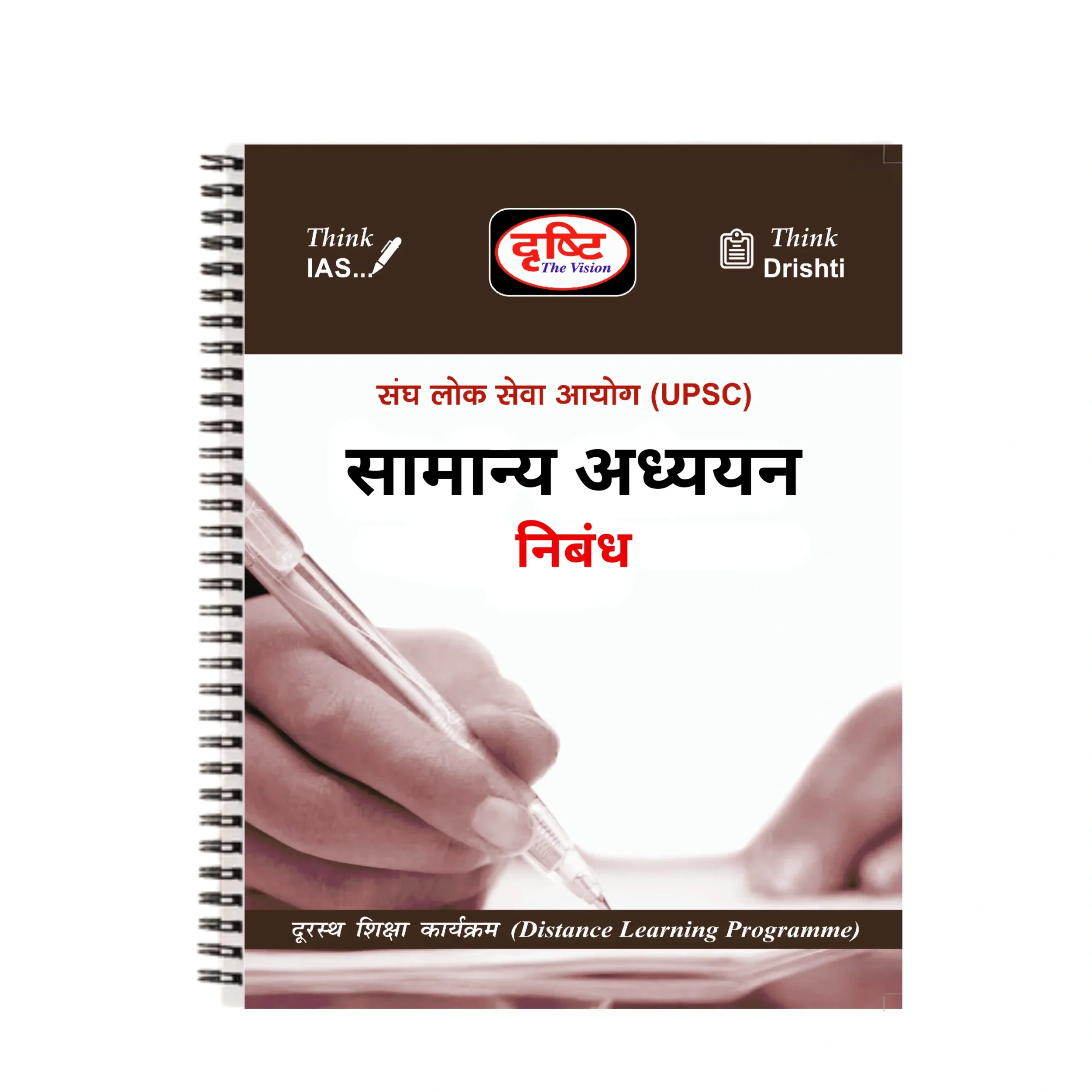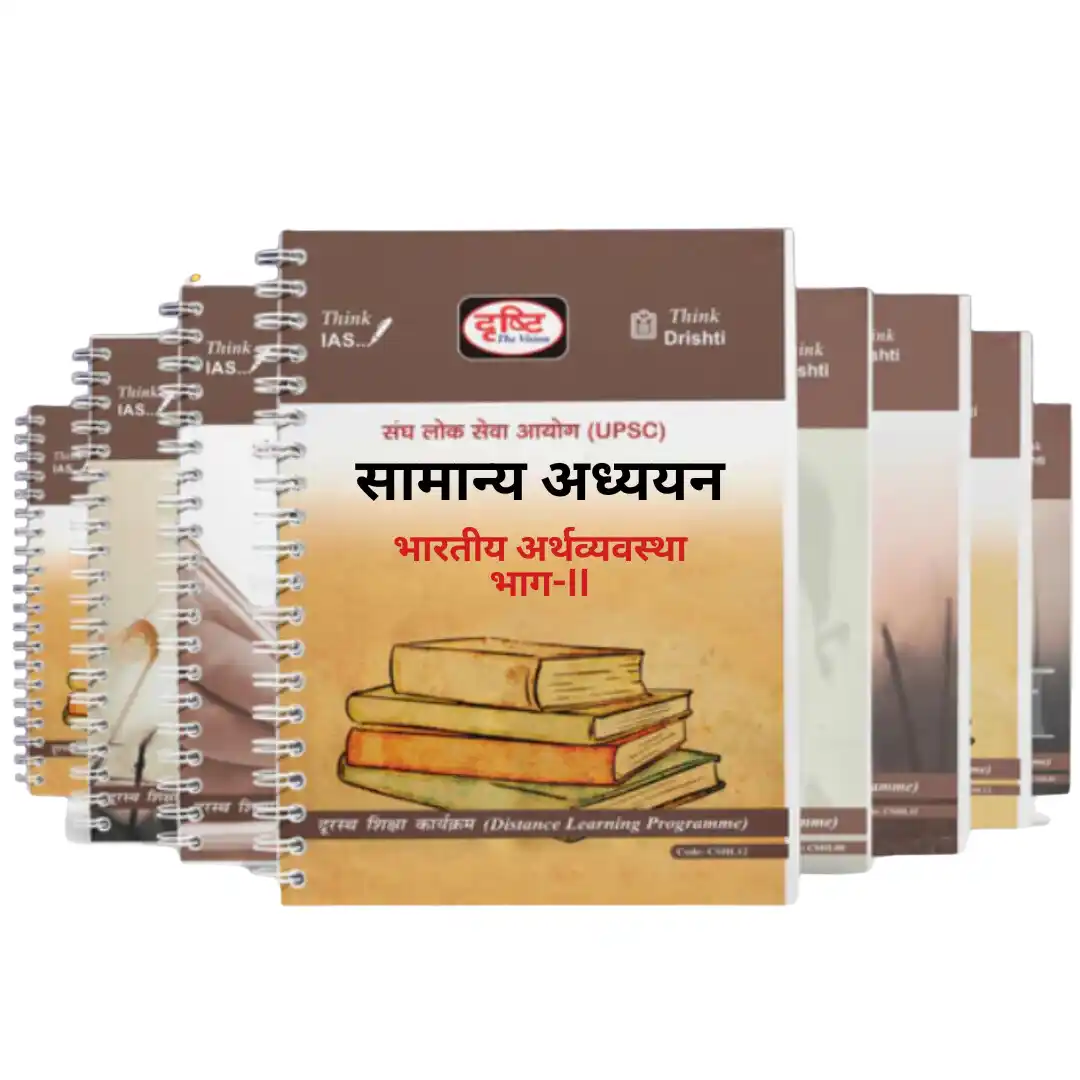

Drishti IAS PSIR Notes | UPSC Prep 2025 | The Definitive Political Science & International Relations Comprehensive Printed Study Material
Product Overview
| Feature | Specification Details |
|---|---|
| Booklets Count | 8 Voluminous Specialized Booklets (Full Syllabus Coverage) |
| Language | English (Academic Proficiency Standard) |
| Publisher | Drishti Publications / Drishti IAS Editorial Board |
| Condition | Brand New (2024-2025 Revised Edition) |
| Format | Premium Printed Hard-Copy (Laser-Edge Quality) |
Complete Booklet Catalog
This comprehensive set for Political Science and International Relations (PSIR) is meticulously divided into eight distinct volumes, ensuring that no sub-topic of the UPSC Civil Services Mains syllabus is left unaddressed. Below is the internal inventory of the set:
- Booklet 1: Western Political Thought (Plato to Marx) - Paper I, Section A.
- Booklet 2: Political Theory & Concepts (Equality, Justice, Rights, Democracy) - Paper I, Section A.
- Booklet 3: Indian Political Thought & Foundations of Indian Government - Paper I, Section B (Part I).
- Booklet 4: Indian Government and Politics (Constitutionalism to Grassroots Democracy) - Paper I, Section B (Part II).
- Booklet 5: Comparative Political Analysis and International Politics (Theory) - Paper II, Section A (Part I).
- Booklet 6: Global Politics, International Relations, and Institutions - Paper II, Section A (Part II).
- Booklet 7: India’s Foreign Policy: Evolution and Regional Dynamics - Paper II, Section B (Part I).
- Booklet 8: India and the World: Global Powers and Strategic Engagement - Paper II, Section B (Part II).
In-Depth Analysis: Paper I Booklets (Section A & B)
The first four booklets in the Drishti IAS PSIR series focus on the core theoretical foundations and the Indian political landscape. Each booklet is structured with a multi-level index that allows the candidate to navigate complex philosophical paradigms with ease.
Booklet 1: The Foundations of Western Political Philosophy
This booklet is the cornerstone of the PSIR syllabus. It features high-density text organized into dedicated chapters for each philosopher. The layout begins with a "Historical Context" box for each thinker, followed by a detailed "Conceptual Framework." For instance, in the chapter on Plato, the physical booklet presents a 15-page deep dive including a unique "Drishti Concept Map" that links the Theory of Justice, Theory of Ideas, and the concept of the Philosopher-King. The paper quality ensures that highlighters do not bleed through, allowing students to mark critical quotes from Aristotle, Machiavelli, Hobbes, Locke, Rousseau, J.S. Mill, and Marx. Each chapter concludes with a "Comparative Analysis" section, physically printed in a grey-shaded box, contrasting the thinkers (e.g., Hobbes vs. Locke on the Social Contract).
Booklet 2: Political Theory and Ideologies
Booklet 2 transitions from thinkers to core concepts. The internal pages are characterized by a clean, two-column layout in specific segments to differentiate between "Traditional Definitions" and "Contemporary Relevance." The section on Justice covers Rawls, Nozick, and Amartya Sen with exhaustive detail. The "Equality" chapter features complex flowcharts illustrating the various dimensions of equality (Legal, Political, Social, Economic). This booklet also includes a "Thematic Index" at the back, allowing students to cross-reference ideologies like Liberalism, Socialism, Marxism, Fascism, and Feminism across different chapters. The "Feminism" section is particularly robust, featuring 40+ pages of printed material covering Liberal, Radical, and Socialist feminist schools of thought.
Booklet 3 & 4: The Indian Political Matrix
These booklets focus on the Indian dimension. Booklet 3 covers Indian Political Thought (Dharamshastra to Ambedkar) with an emphasis on the synthesis of traditional and modern political ideas. The physical pages of the Ambedkar section include dedicated sub-headers for "Annihilation of Caste" and "Constitutionalism." Booklet 4 is the largest in the Paper I series, focusing on the Indian Constitution. It utilizes a "Point-Wise Internal Structure" for every article and amendment discussed. There are dedicated tabular comparisons for "Fundamental Rights vs. Directive Principles" and "Presidential vs. Parliamentary Systems." The ink used is deep-black, high-contrast, ensuring legibility even under low-light study conditions.
In-Depth Analysis: Paper II Booklets (Section A & B)
Paper II is inherently dynamic. Drishti IAS has addressed this by integrating "Contemporary Connection" boxes throughout the printed text. These booklets are updated for the 2025 cycle, reflecting recent global geopolitical shifts.
Booklet 5 & 6: Comparative Politics and IR Theory
Booklet 5 tackles the most abstract part of Paper II. The "Comparative Politics" section is structured around thematic comparison tables (e.g., Political Economy, Dependency Theory, World Systems Theory). Booklet 6 focuses on IR theories—Realism, Liberalism, Marxism, Constructivism, and Functionalism. The physical layout utilizes "Scholar Citation" marginalia, where the names of key thinkers like Morgenthau, Waltz, and Keohane are printed in bold in the margins for quick visual scanning. This booklet includes over 30 high-resolution maps and diagrams illustrating the evolution of the United Nations and other regional organizations like the EU and ASEAN.
Booklet 7 & 8: India and the Global Order
These final two booklets are arguably the most visual in the set. Booklet 7 deals with the evolution of India's Foreign Policy (IFP). The physical pages include "Timeline Ribbons" at the bottom of the page to show the progression from Nehru’s Non-Alignment to the current "Multi-Alignment" strategy. Booklet 8 focuses on bilateral relations (India-USA, India-China, India-Russia). These chapters use a "Strategic Interest Matrix"—a printed table that summarizes the "Points of Convergence" and "Points of Divergence" for each country. The final section of Booklet 8 contains a "Drishti Special: International Current Affairs Supplement," which is a printed digest of the most significant global events of the last 18 months that impact India’s strategic posture.
Physical Specifications and Material Quality
The Drishti IAS PSIR notes are not mere photocopies; they are high-quality printed study materials designed for long-term durability and ergonomic usage. The physical construction of these booklets is a critical factor for UPSC aspirants who spend 10-12 hours daily with these materials.
1. Paper Grade and Optical Comfort
Every page in this 8-booklet set is printed on 75 GSM (Grams per Square Meter) Maplitho Paper. This specific grade is chosen for its "Pure White" finish and high opacity, which prevents the "Ghosting Effect" (ink showing through from the other side). The paper has an anti-glare matte coating, reducing eye strain during marathon night-study sessions. The surface texture is optimized for both ballpoint and gel pen annotations, as well as highlighters, without causing smudging or paper warping.
2. Print Technology and Ink Longevity
Drishti uses High-Definition (HD) Offset Printing for these notes. Unlike standard digital xerox prints that can fade over time or smudge when exposed to moisture, the ink in these booklets is chemically bonded to the paper fibers. The text is rendered in a 10.5-point "ClearView" Serif font, which balances information density with readability. Headings are printed in a bold, sans-serif font to create a clear visual hierarchy on the page.
3. Binding and Structural Integrity
Recognizing that these booklets will be opened, folded, and carried in backpacks for months, the binding is Reinforced Thermal Glue Binding or Industrial-Grade Spiral Binding (depending on the specific batch edition). The covers are made of 250 GSM laminated cardstock, providing a moisture-resistant barrier for the internal pages. Each booklet is "Edge-Trimmed" to ensure that the pages do not fray or curl at the corners with frequent use.
4. Organizational Aids
Each booklet features a Die-Cut Color-Coded Header on the internal pages, making it easy to identify which booklet you are holding even when they are stacked. The page numbering is continuous within each section but also indicates the total page count for that specific module (e.g., Page 45 of 210), helping students track their progress accurately.
Exclusive "Drishti Special" Internal Features
What sets these printed notes apart are the pedagogical tools integrated into the page layouts. These features are designed to mimic the classroom experience and provide the student with "answer-ready" content.
The "Concept Cloud" Diagrams
Scattered throughout the booklets are "Concept Clouds"—hand-drawn and then digitally rendered diagrams that synthesize complex theories. For example, the "Global Commons" in International Relations is presented as a central hub with spoke-like extensions to Climate Change, Maritime Security, and Outer Space, giving the student a visual template for a 15-mark answer.
"Previous Year Question" (PYQ) Integration
At the end of every chapter, there is a dedicated "PYQ Tracker" section. This is a printed list of all UPSC Mains questions related to that specific topic from 2013 to 2023. These questions are not just listed; they are cross-referenced to the page numbers within the booklet where the answer content can be found. This turns the study material into a functional exam-cracking tool.
The "Scholar Sidebar"
To score high in PSIR, one must cite scholars. Drishti has simplified this by including "Scholar Sidebars"—vertically oriented boxes on the side of the page that list 3-5 essential scholars and their famous works related to the topic on that page. This allows for rote memorization of names like Granville Austin, Atul Kohli, or Pratap Bhanu Mehta in the context of Indian Politics.
Frequently Asked Questions (FAQ)
1. Are these notes the exact printed version of the Drishti IAS classroom lectures?
Yes, these are the official "Distance Learning Programme" (DLP) notes, which are a refined and more structured version of the handwritten notes taken by students in the Drishti IAS classrooms. They are edited by the editorial board to ensure grammatical precision and updated facts for the 2025 exam.
2. How does the 2025 edition differ from the 2024 edition?
The 2025 edition includes approximately 15% new content. This specifically pertains to the Paper II International Relations sections, including the latest developments in the Russia-Ukraine conflict, the Middle East crisis (Israel-Hamas), India's G20 Presidency outcomes, and the latest updates on the "Act East" policy and "Neighbourhood First" policy.
3. Is the printing quality suitable for extensive highlighting?
Absolutely. The 75 GSM Maplitho paper is specifically selected for its "Bleed-Proof" properties. You can use standard neon highlighters or even mild liners without the ink seeping through to the text on the reverse side of the page.
4. Does the set include current affairs, or do I need to buy them separately?
The set includes all the foundational current affairs up to the date of publication. However, for PSIR Paper II, current affairs are an ongoing process. While the booklets provide the "Static-Dynamic Linkage" framework, we recommend following the Drishti IAS monthly magazine to supplement the notes for events occurring after mid-2024.
5. Are the maps and diagrams in the IR booklets clear enough to read?
Yes, the diagrams are printed using high-resolution vector graphics. Unlike blurry photocopies, the lines, labels, and legends on the maps (such as the South China Sea map or the Arctic Council map) are sharp and legible.
6. Is this set sufficient for the PSIR Optional syllabus, or do I need textbooks?
While the UPSC syllabus is vast, these notes are designed to be "Self-Sufficient." They synthesize content from standard textbooks like O.P. Gauba, Andrew Heywood, and V.N. Khanna. For 95% of the syllabus, these notes provide more than enough depth to write a 250-word answer.
7. How are the booklets shipped to ensure they aren't damaged?
Each 8-booklet set is first shrink-wrapped in plastic to prevent moisture damage. Then, they are placed in a corrugated cardboard box with reinforced corners. Finally, the box is wrapped in a waterproof courier bag for final transit.
8. Is the font size large enough for students with visual strain?
The notes use a 10.5 to 11-point font size with 1.2 line spacing. This is the industry standard for academic printing, specifically designed to maximize information per page while maintaining a comfortable reading experience for several hours.
9. Are these notes available in Hindi?
This specific listing is for the English Medium set. Drishti IAS does produce a Hindi version, but the translation and content flow are customized for the Hindi academic context. Please ensure you are purchasing the correct language set for your UPSC medium.
10. Can I verify the authenticity of these Drishti IAS notes?
Authentic Drishti IAS DLP notes feature specific watermarks on select pages and the "Drishti" logo on the cover with high-quality lamination. The consistency of the 75 GSM paper and the offset printing quality (as opposed to cheap laser jet printing) are the primary indicators of a genuine product.