
Drishti IAS Indian Society & Social Justice (Hindi Medium) – Complete UPSC Mains Study Material & Printed Notes
Product Overview
| Feature | Specification Details |
|---|---|
| Booklets Count | 2 Comprehensive Printed Volumes (GS Paper I: Society & GS Paper II: Social Justice) |
| Language | Hindi (Standard Academic Devanagari) |
| Publisher | Drishti IAS (Delhi Center Official Curriculum) |
| Condition | Brand New (Latest 2024-25 Curriculum Edition) |
| Format | High-Quality Laser Printed Hard Copy (Spiral/Perfect Bound Options) |
Complete Booklet Catalog
This premium study set consists of the following meticulously curated booklets, designed specifically for the Civil Services Examination (Mains):
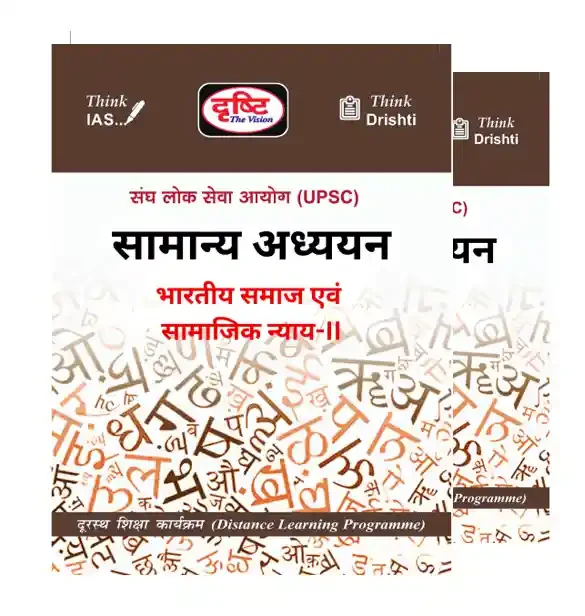
- Booklet 1: Bhartiya Samaj (Indian Society) - Covering the complete General Studies Paper I syllabus including Diversity, Globalization, and Secularism.
- Booklet 2: Samajik Nyaya (Social Justice) - Covering the complete General Studies Paper II syllabus including Welfare Schemes, Health, Education, and Vulnerable Sections.
- Supplements: Integrated Previous Year Questions (PYQs) and Model Answer Templates included within the chapters.
Physical Manufacturing & Build Standards
The physical construction of the Drishti IAS Society & Justice notes is engineered for the rigors of long-term intensive study. Recognizing that a UPSC aspirant spends upwards of 10 hours a day with their material, the manufacturing process adheres to "Elite Grade" standards.
Premium 75 GSM Maplitho Paper
Unlike standard photocopied notes found in local markets, these booklets utilize 75 GSM high-opacity Maplitho paper. This ensures a "No-Bleed" experience; you can use highlighters, fountain pens, or gel pens to mark key concepts without the ink seeping through to the reverse side. The paper features an off-white, anti-glare finish, specifically chosen to reduce eye strain during late-night study sessions under artificial lighting.
Laser-Tech Printing & Ink Longevity
The text is rendered using industrial-grade high-resolution laser printers. The ink is thermally bonded to the paper fibers, ensuring that the text does not smudge, fade, or rub off over time. This is critical for the "Social Justice" booklet, which contains dense data tables and flowcharts that require sharp clarity for legibility.
Reinforced Binding & Portability
Each booklet is equipped with a thick 300 GSM laminated cover page to protect the internal content from moisture and wear. The binding is reinforced with high-tensile strength adhesives (Perfect Binding) or heavy-duty plastic coils (Spiral Binding), allowing the book to lay completely flat on a desk—a necessity for comfortable note-taking and mapping.
In-Depth Analysis: Booklet 1 – Bhartiya Samaj (Indian Society)
This volume serves as the cornerstone for GS Paper I. It is not merely a collection of facts but a sociological exploration of the Indian landscape. The booklet is divided into several high-yield modules:
Chapter 1: Salient Features of Indian Society
The booklet begins with an exhaustive index detailing the "unity in diversity" of India. It covers the hierarchical nature of society, the family system, and the transition from joint families to nuclear families. Each page features a "Drishti Insight" box that provides contemporary examples of how traditional values are merging with modern lifestyles.
Chapter 2: Role of Women and Women’s Organizations
This section is data-heavy, focusing on the historical trajectory of women's movements in India. It lists every major women's organization from the pre-independence era to modern SHGs (Self-Help Groups). The physical layout includes dedicated margins for students to add current news updates regarding women’s safety and economic participation.
Chapter 3: Population and Associated Issues
The booklet provides detailed demographic transitions based on the latest Census and NFHS-5 data. It breaks down the "Demographic Dividend" into digestible charts, illustrating the challenges of poverty and developmental issues. The printing quality ensures that even the smallest data points in the population pyramids are crystal clear.
Chapter 4: Effects of Globalization on Indian Society
One of the most complex topics is handled with exceptional clarity. The booklet analyzes globalization's impact on food, clothing, language, and social values. It uses a "Pros vs. Cons" tabular format, making it easy for the aspirant to memorize points for the Mains exam. The use of bold headers and bullet points throughout this section enhances visual memory retention.
Chapter 5: Social Empowerment, Communalism, Regionalism & Secularism
This is the most critical section for GS-I. The booklet provides a neutral, UPSC-centric perspective on sensitive topics. It defines the core tenets of Indian Secularism versus Western Secularism, a distinction frequently asked in the exam. The content is structured to help the student write balanced answers that reflect the constitutional morality of India.
In-Depth Analysis: Booklet 2 – Samajik Nyaya (Social Justice)
Booklet 2 shifts the focus toward the governance and administrative aspect of society. It is an essential companion for GS Paper II and provides the "fodder material" required for high-scoring essays.
Chapter 1: Welfare Schemes for Vulnerable Sections
The physical layout of this chapter is revolutionary. Instead of long paragraphs, the schemes are presented in a tabular format: Name of Scheme, Objective, Target Audience, Funding Pattern, and Current Performance. This includes schemes for SCs, STs, OBCs, Minorities, and the Differently-abled (Divyangjan). The laser-printed tables ensure that the complex multi-column data is easy to navigate.
Chapter 2: Mechanisms, Laws, Institutions and Bodies
This section covers the statutory and constitutional bodies like the NCSC, NCST, and NHRC. The booklet provides the "powers and functions" of these bodies in a point-wise format, which is exactly how the UPSC demands answers to be written. The internal index for this chapter is highly detailed, allowing for quick revision of specific Articles of the Constitution.
Chapter 3: Health, Education, and Human Resources
Health and Education are pillars of Social Justice. This booklet provides deep-dive reports on the New Education Policy (NEP 2020), the National Health Policy, and the issues of malnutrition and hunger. The text incorporates Global Hunger Index rankings and NITI Aayog's SDG India Index reports directly into the content flow.
Chapter 4: Poverty and Hunger Issues
The booklet discusses the "Cycle of Poverty" through high-resolution diagrams. It analyzes the effectiveness of the PDS system, food security, and the hidden hunger (micronutrient deficiency). This section is particularly useful for the "Economy" section of GS-III as well, showing the interdisciplinary nature of the Drishti IAS material.
Drishti/Vision Special Features: Pedagogy & Design
What sets these printed notes apart is the internal "Learning Architecture" designed by the Drishti IAS content team:
The 'Flowchart' Advantage
Nearly every 5th page contains a conceptual flowchart. For instance, the transition from "Traditional Society" to "Modern Society" is visualized through a logical map. This reduces the cognitive load on the student and provides a ready-to-draw diagram for the actual exam paper.
Integrated Mains Practice
At the end of every chapter, there is a dedicated "Mains Practice Section." This includes questions from the last 10 years of UPSC exams and "Probable Future Questions." These are printed with ample spacing, allowing students to mentally draft their structure before looking at the provided hints.
The 'Value Addition' Boxes
Throughout the booklets, you will find "Value Addition" boxes containing quotes from famous sociologists, constitutional experts, or the Prime Minister. These are highlighted with a light grey background to stand out from the main text, ensuring you don't miss these "extra-mark" generators.
Strategic Utility for the UPSC Aspirant
Possessing these notes provides a massive competitive advantage. In the Hindi medium segment, resources are often scattered; Drishti IAS has consolidated the standard reference books (like Ram Ahuja and NCERTs) into these two streamlined booklets.
The "Society & Justice" notes are designed to be "Self-Sufficient." A student who masters these two volumes will not need to consult any other textbook for these sections of the GS syllabus. The language is sophisticated yet accessible, mimicking the "Standard Hindi" required by the UPSC personality test and mains answer writing.
Frequently Asked Questions (FAQ)
1. Are these notes the latest edition for the upcoming UPSC attempt?
Yes, these notes are sourced from the most recent batch of the Drishti IAS Delhi classroom program. They include the latest 2024-2025 updates, including the latest budgetary allocations for social welfare schemes and recent Supreme Court judgments regarding social issues.
2. Is the Hindi used in these booklets easy to understand?
The notes use "Prashasnik Hindi" (Administrative Hindi), which is the standard language used in the UPSC Mains exam. It is academic and formal but explained through clear headings and bullet points to ensure even students coming from an English background can grasp the concepts easily.
3. How is the paper quality for long-term usage?
We use 75 GSM Maplitho paper. This is significantly higher quality than the 50-60 GSM paper used in cheap photocopies. It is designed to last for years without yellowing, and it is thick enough to support heavy highlighting and marginalia.
4. Does this package cover both GS Paper I and GS Paper II?
Yes. The "Indian Society" booklet covers the Society portion of GS Paper I, while the "Social Justice" booklet covers the governance and justice portion of GS Paper II. It is a complete thematic solution.
5. Is this material sufficient for the Essay Paper as well?
Absolutely. Social issues are a favorite topic for the UPSC Essay paper. The "Social Justice" booklet provides the statistics, philosophy, and government perspectives necessary to write a 1000-1200 word high-quality essay on topics like education, women, or poverty.
6. Are there any diagrams or flowcharts included?
Yes, the notes are heavily visual. Drishti IAS emphasizes visual learning, so you will find hundreds of flowcharts, conceptual maps, and data tables that are specifically designed for quick revision and reproduction in the exam.
7. How are the booklets packaged for shipping?
Each set is double-wrapped in bubble wrap and placed in a moisture-resistant courier bag or cardboard box to ensure that the corners are not damaged and the paper remains dry during transit.
8. Do these notes include current affairs?
The notes cover the core static syllabus and include current affairs up to the date of printing. For very recent developments (the last 2-3 months), students are advised to supplement these notes with the Drishti Current Affairs Magazine.
9. Can I use these notes for State PCS exams?
Yes, these are highly beneficial for state exams like UPPCS, BPSC, and RAS, as the syllabus for Indian Society and Social Justice in state exams is almost identical to the UPSC syllabus.
10. Is there a table of contents (index) in each booklet?
Every booklet features a detailed, multi-level table of contents. This allows you to find specific topics like "Secularism" or "MGNREGA" within seconds, making it an excellent tool for rapid revision in the weeks leading up to the Mains exam.