
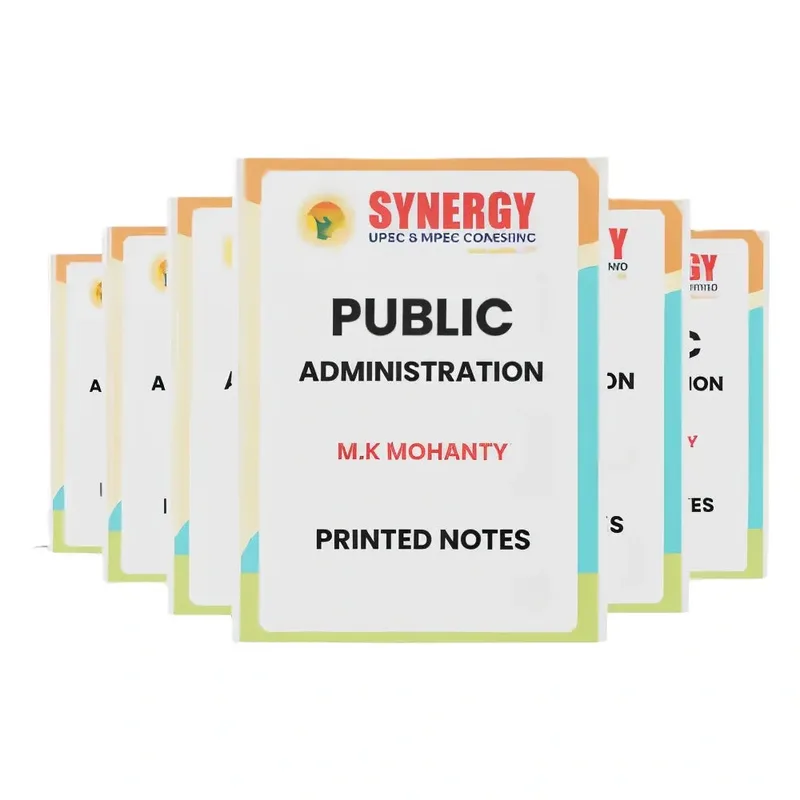
MK Mohanty Public Administration (Notes 2025-26 Edition) | Ultimate UPSC Civil Services Study Material | Synergy IAS Standard
| Product Feature | Specifications & Details |
|---|---|
| Booklets Count | 10 Comprehensive Volumes (Covering Paper I and Paper II) |
| Language | English (Academic Standard for UPSC CSE) |
| Publisher | Synergy IAS - MK Mohanty Official Curriculum Prints |
| Condition | Brand New (Latest 2025-26 Revised Edition) |
| Format | High-Quality Printed Booklets (Spiral Bound for ease of reading) |
| Paper Quality | 75 GSM Ultra-White Bond Paper (Anti-Glare / No Bleed) |
Complete Booklet Catalog: Systematic Syllabus Mapping
The MK Mohanty Public Administration package is divided into ten distinct booklets, each meticulously curated to align with the latest UPSC syllabus requirements. The breakdown of these booklets is as follows:
- Booklet 1: Administrative Theory - Part A (Introduction, Meaning, Scope, and Evolution of Public Administration).
- Booklet 2: Administrative Theory - Part B (Administrative Thought: Classical, Neo-Classical, and Behavioral Schools).
- Booklet 3: Administrative Behaviour (Decision Making, Leadership, Motivation, and Communication).
- Booklet 4: Organizations & Accountability (Structure, Theories, Accountability and Control, Administrative Law).
- Booklet 5: Comparative Public Administration & Development Dynamics (CPA, Development Administration, and Public Policy).
- Booklet 6: Financial Administration & Administrative Improvement (Budgeting, Techniques, and Management Information Systems).
- Booklet 7: Indian Administration - Part A (Evolution, Philosophical/Constitutional Framework, and Public Sector Undertakings).
- Booklet 8: Indian Administration - Part B (Union/State/District Administration and Civil Services).
- Booklet 9: Financial Management & Administrative Reforms (Control of Expenditure, Reforms since Independence, and Rural/Urban Local Government).
- Booklet 10: Significant Issues in Indian Administration (Law and Order, Human Rights, Gender Issues, and Crisis Management).
In-Depth Physical Quality & Manufacturing Standards
The MK Mohanty Public Administration Notes 2025-26 edition is not just a collection of information; it is a high-performance physical product engineered for the rigors of the UPSC preparation cycle. We understand that aspirants spend 8–12 hours daily with these materials, and thus, the physical build quality is prioritized to prevent eye strain and physical degradation.
1. Paper Specifications: 75 GSM Executive Bond
Each booklet is printed on 75 GSM (Grams per Square Meter) paper. Unlike standard 50-60 GSM paper used in mass-market xerox copies, this paper offers a significant tactile difference. It is "bleed-proof," meaning students can use highlighters (even dark ink variants) or fountain pens for note-making without the ink seeping through to the reverse side. The paper has an "Ultra-White" finish but with a specialized anti-glare coating that reduces the reflection of overhead study lamps, preventing ocular fatigue during late-night sessions.
2. Printing Technology: 1200 DPI High-Definition Laser
The internal text utilizes high-definition laser printing. This ensures that even the smallest font sizes (used in citations and footnotes) are razor-sharp. Diagrams, particularly the complex flowcharts in Booklet 2 (Administrative Thought) and the organizational hierarchies in Booklet 7, are rendered in high contrast. There are no smudges, faded lines, or "printer streaks" that are common in low-quality pirated versions.
3. Binding and Durability: Heavy-Duty Spiral Architecture
Each volume is bound using an industrial-grade plastic or metallic double-O spiral. This allows the booklet to lay 100% flat on a desk, which is essential for taking notes in the margins. The front and back covers are protected by a 300 GSM transparent or frosted plastic sheet, providing a moisture barrier and preventing the corners of the internal pages from "dog-earing" over months of heavy usage.
Deep Dive: Detailed Internal Content Analysis (Booklet 1 to 10)
The internal content of the MK Mohanty notes is legendary for its "pedagogical flow." Rather than presenting dry facts, the booklets are structured as an "Evolutionary Narrative" of Public Administration.
Booklet 1 & 2: The Foundation of Administrative Theory
These booklets contain the most critical content for Paper I. Booklet 1 begins with an exhaustive index detailing the shift from the "Wilsonian Dichotomy" to the "Post-New Public Management" era. It includes a comprehensive table of contents that lists internal sub-sections such as "The Paradigm Shift of Nicholas Henry" and "The Minnowbrook I, II, and III Comparisons."
Booklet 2 focuses on "Administrative Thought." This is the thickest booklet in the set. Inside, you will find dedicated sections for each thinker. For instance, the section on Max Weber contains not just his theory of Bureaucracy, but also a dedicated index sub-point for "Weber’s Rational-Legal Authority vs. Traditional Authority." The notes utilize "Comparison Tables"—for example, a side-by-side comparison of Taylor’s Scientific Management and Fayol’s Administrative Management. Every theorist section ends with a "Criticism Index," which lists the viewpoints of other scholars, making it an all-in-one resource for answer writing.
Booklet 3: Administrative Behaviour - Psychology of Administration
This booklet’s internal structure is unique. It integrates psychological concepts with administrative reality. The "Decision Making" chapter features Herbert Simon’s "Bounded Rationality" model, illustrated with proprietary MK Mohanty flowcharts that simplify the "Satisficing" vs. "Optimizing" concepts. The "Motivation" chapter includes the theories of Maslow, Herzberg, and McGregor, with specific margin notes on how these apply to the modern Indian Civil Services. The font spacing is optimized here to allow students to map these theories to Paper II (Indian Administration) examples.
Booklet 4: The Legal and Structural Framework
The internal content here covers "Organizations" and "Administrative Law." The index lists "Staff, Line, and Auxiliary Agencies" with exhaustive real-world examples from the Government of India ministries. The Administrative Law section includes a detailed "Case Law Index" which provides summaries of landmark judgments. This is a "Drishti/Vision Special" feature where the notes cross-reference legal principles with contemporary administrative challenges.
Booklet 5 & 6: Global Perspectives and Fiscal Management
Booklet 5 covers Comparative Public Administration (CPA). The index lists "Riggs’ Prismatic Society" and "Sala Model" with detailed diagrams representing the "Fused-Prismatic-Diffracted" continuum. Booklet 6 focuses on Financial Administration. The content here is highly technical, featuring the "Budgetary Cycle" in India, the role of the CAG (Comptroller and Auditor General), and "Performance-Based Budgeting." The internal pages include actual snapshots of budgetary formats and historical data tables for contextual understanding.
Booklet 7 & 8: The Indian Administrative Landscape
Moving to Paper II, Booklet 7 explores the "Evolution of Indian Administration." The index begins with Kautilya’s Arthashastra, the Mughal Administration, and the British Legacy. The physical layout uses "Historical Timeline" graphics to show the continuity of administrative practices. Booklet 8 deals with the Union and State Government. It contains a detailed breakdown of the PMO (Prime Minister’s Office), the Cabinet Secretariat, and the NITI Aayog. The notes include "Comparative Tables" between the Chief Secretary of a State and the Cabinet Secretary of the Union.
Booklet 9 & 10: Local Governance and Modern Issues
Booklet 9 covers the 73rd and 74th Constitutional Amendment Acts. The internal content lists every major committee from Balwant Rai Mehta to Gadgil. It includes a specific "Urban Local Bodies" index featuring the latest challenges like "Smart Cities Mission." Booklet 10 is the most dynamic booklet. It contains "Current Affairs Integration." The index lists "Law and Order Administration," "Police-Public Relations," "Disaster Management Framework," and "Ethics in Administration." It is packed with contemporary case studies from the 2nd Administrative Reforms Commission (ARC) reports.
Internal Pedagogical Features: The "Synergy" Advantage
Every page of the MK Mohanty 2025-26 notes is designed with specific "Answer Writing Enrichment" features:
- The "Contextual Box": At the beginning of every chapter, there is a grey-shaded box explaining why that topic is relevant to the current UPSC trend.
- Inter-Linkage Points: Every booklet contains "Linkage Icons" in the margins. These tell the student, for example, "Link this concept of Weber from Booklet 2 to the Civil Services chapter in Booklet 8." This helps in developing the holistic view required for Paper II.
- Keyword Glossaries: At the end of each booklet, there is a 5-page glossary of "High-Value Keywords" (e.g., *Teleological*, *Dichotomy*, *Subsidiarity*, *Social Equity*) which students can use to improve their language in the mains exam.
- Previous Year Question (PYQ) Mapping: Every chapter ends with a list of questions asked in the UPSC Mains from 2013 to 2024 related to that specific topic. The notes are internally structured to provide the exact data points needed to answer these specific questions.
Shipping, Packaging, and Quality Assurance
When you order the "MK Mohanty Pub Admin Notes 2025-26," you are receiving a premium academic product. Our fulfillment process is as follows:
- Collation: All 10 booklets are checked for page continuity and print clarity. We ensure no pages are blank or missing.
- Moisture Protection: The entire set is vacuum-sealed in a high-density polyethylene (HDPE) bag to prevent any water damage during transit, especially during monsoon seasons.
- Shock Absorption: The sealed set is wrapped in two layers of 10mm bubble wrap and placed inside a corrugated cardboard box (3-ply or 5-ply) to prevent corner damage or spiral deformation during courier handling.
- Security: The package is sealed with "Tamper-Evident" tape. If the tape appears disturbed, the customer is advised not to accept the delivery.
Why These Notes are "Elite" Class Material
The MK Mohanty notes are widely considered the "Gold Standard" for Public Administration. The reason lies in the internal "Content Density." While other materials might provide 500 pages of fluff, these 10 booklets provide 1800+ pages of high-density academic content.
The 2025-26 edition specifically includes updates from the 15th Finance Commission, the Latest NITI Aayog Reports, and references to the New Education Policy's administrative implications. The physical quality ensures that the student can treat these notes as a "Workbook" rather than just a reading material. The wide margins (approx. 1.5 inches) are left intentionally blank to allow for "Value Addition" from current affairs or newspaper snippets (like The Hindu or Indian Express editorials).
Frequently Asked Questions (FAQ)
1. Are these notes the original MK Mohanty Synergy IAS classroom notes or just a summary?
These are the comprehensive, full-length classroom study materials provided by Synergy IAS under MK Mohanty’s guidance. They are not a "summary" or "short notes"; they are the complete syllabus coverage required for both Paper I and Paper II of the UPSC Public Administration optional.
2. Does this 2025-26 edition include the latest 2nd ARC Report recommendations?
Yes. Every relevant booklet (specifically Booklet 4, 8, and 10) has been updated with recommendations from the 2nd Administrative Reforms Commission. These are integrated directly into the text rather than being provided as an appendix, ensuring a seamless learning experience.
3. How is the print quality compared to local market xerox copies?
There is a significant difference. These are "First-Gen Prints," meaning they are printed directly from digital masters on 75 GSM paper using high-end laser printers. Local market copies are often "Third-Gen Xeroxes" where the text becomes blurry, the diagrams lose detail, and the paper is usually 50 GSM greyish paper that bleeds ink.
4. Is the binding strong enough to last for a 2-year preparation cycle?
Absolutely. We use industrial-strength double-O spiral binding and thick 300 GSM protective covers. The spiral diameter is chosen to ensure that pages do not get stuck or tear when flipped rapidly during revision.
5. Can I use these notes if I am a complete beginner in Public Administration?
Yes. Booklet 1 is specifically designed for beginners. It starts with the most basic definitions of "What is Administration?" and gradually builds up to complex theories. The language is academic yet accessible, with internal glossaries to help you master the terminology.
6. Do the notes cover the "Current Affairs" part of Paper II?
Yes. Booklet 10 is dedicated to "Significant Issues in Indian Administration" and is updated with the latest 2024-25 data, including topics like lateral entry in civil services, the impact of AI on governance, and modern law and order challenges. However, students are always encouraged to supplement this with daily news.
7. What is the total weight of the package, and is it portable?
The total set of 10 booklets weighs approximately 3.5 to 4.2 KG. While the entire set is heavy, the modular 10-booklet design makes it highly portable. You can carry just one booklet (e.g., Booklet 2 on Administrative Thought) in your bag for study at a library or cafe without carrying the entire weight.
8. Is there any "Watermarking" on the pages that obscures the text?
No. We use a very faint, light-grey transparent watermark that does not interfere with reading or highlighting. We prioritize the student's reading experience over aggressive branding.
9. Are there any diagrams and flowcharts in the booklets?
Public Administration is a visual subject. The MK Mohanty notes are famous for their "Schematic Representations." There are over 300+ flowcharts, tables, and conceptual maps across the 10 booklets to help you visualize complex organizational structures and theoretical models.
10. How do I verify the authenticity of this 2025-26 edition?
The 2025-26 edition features a specific cover design and updated indices that include 2024 UPSC Mains questions. The paper quality (75 GSM) and the crispness of the laser print are the primary indicators of its high-grade production standard compared to older or counterfeit versions.
11. Is the material sufficient for the UPSC Mains exam without reading standard textbooks like Prasad & Prasad or Nicholas Henry?
While standard textbooks are good for reference, these notes are designed to be "Self-Sufficient." They extract the core arguments from 15+ standard textbooks (including Prasad & Prasad, Fadia & Fadia, and Ramesh K. Arora) and present them in a format that is ready for answer writing. Most toppers use these notes as their primary source and textbooks only for secondary clarification.
12. What if a booklet is damaged during shipping?
We have a 100% replacement guarantee for shipping damage. If the spiral is crushed or the paper is soaked despite our heavy-duty bubble wrap and HDPE packaging, we will send a replacement booklet immediately upon verification of the damage video.
End of Product Description for MK Mohanty Public Administration Notes 2025-26 Edition.