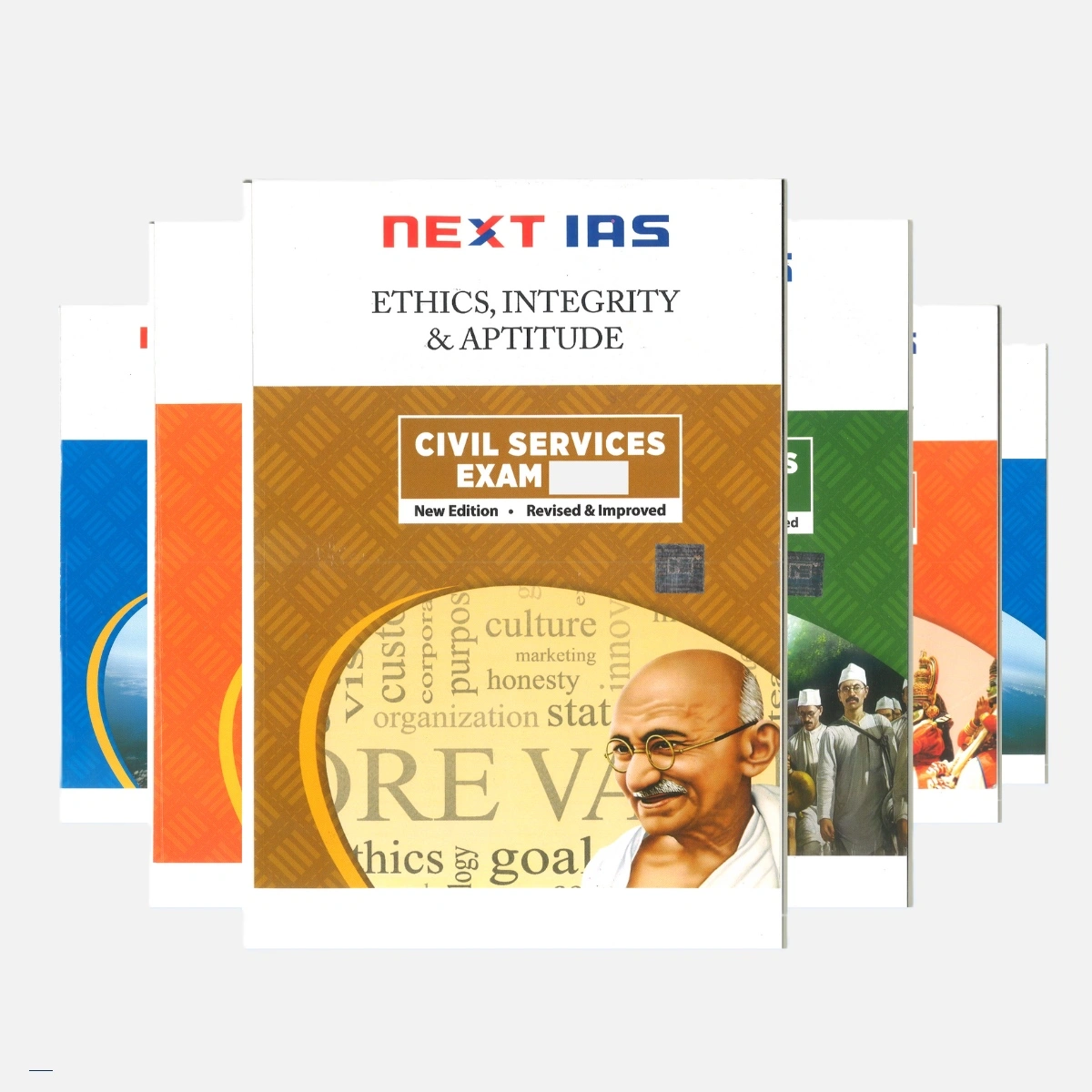

Next IAS General Studies Comprehensive Notes 2025-26: The Ultimate 18-Booklet UPSC Civil Services Preparation Suite
Product Overview
| Feature | Specification Details |
|---|---|
| Booklets Count | Set of 18 Individual Subject-Specific Volumes |
| Language | English (Academic Proficiency Level) |
| Publisher | Next IAS (Made Easy Group) Official Publications |
| Condition | Brand New (Latest 2025-26 Printing Cycle) |
| Format | High-Quality Printed Physical Books (Softbound/Spiral Integrated) |
| Syllabus Coverage | UPSC CSE Prelims + Mains (GS Paper I, II, III, and IV) |
Complete Booklet Catalog
The following list represents the exhaustive inventory of the 18-booklet set provided in this Next IAS GS 2025-26 package. Each volume is indexed according to the official UPSC syllabus mapping.
- Booklet 1: Ancient History of India (Prehistoric to Post-Gupta Era)
- Booklet 2: Medieval History of India (Sultanate, Mughals, and Marathas)
- Booklet 3: Modern Indian History (Advent of Europeans to 1947)
- Booklet 4: Post-Independence India and World History (18th Century to Modern Era)
- Booklet 5: Art and Culture (Architecture, Sculpture, Paintings, and Performing Arts)
- Booklet 6: Physical Geography (Geomorphology, Climatology, and Oceanography)
- Booklet 7: Indian and World Geography (Resources, Mapping, and Human Geography)
- Booklet 8: Indian Polity and Constitution (Part I: Framework and Rights)
- Booklet 9: Indian Governance and Social Justice (Schemes, Policies, and Vulnerable Sections)
- Booklet 10: International Relations (Bilateral, Regional, and Global Groupings)
- Booklet 11: Indian Economy - Macro Concepts and Core Sectors
- Booklet 12: Indian Economy - Agriculture, Budgeting, and Fiscal Policy
- Booklet 13: Environment, Ecology, and Climate Change
- Booklet 14: Science and Technology (Space, Defense, IT, and Biotechnology)
- Booklet 15: Ethics, Integrity, and Aptitude (Section A: Theory and Philosophers)
- Booklet 16: Ethics Case Studies and Applied Integrity (Section B)
- Booklet 17: Internal Security (Terrorism, Insurgency, and Cyber Warfare)
- Booklet 18: Disaster Management and Social Issues
Industrial-Grade Physical Construction & Print Standards
This Next IAS GS Notes set is engineered for high-intensity study environments. The physical attributes of these booklets ensure longevity throughout the 18-month UPSC preparation cycle. We prioritize tactile feedback and visual clarity to prevent ocular fatigue during extended reading sessions.
75 GSM Premium "Eye-Comfort" Paper
The internal pages are printed on 75 GSM (Grams per Square Meter) high-grade paper. Unlike standard 50-60 GSM paper found in cheaper replicas, this thickness ensures that highlighters and ink pens do not bleed through to the reverse side. The paper features a slight cream-white tint specifically chosen to reduce glare under LED study lamps, facilitating longer retention sessions without eye strain.
High-Definition Laser Printing and Ink Stability
Each booklet utilizes anti-glare, smudge-proof black ink applied via high-definition laser printing. This ensures that the intricate diagrams—such as the plate tectonics maps in the Geography booklet or the constitutional flowcharts in the Polity volume—remain crisp and legible. The ink is chemically bonded to the fiber, ensuring that the text does not fade over time even in humid conditions.
Reinforced Binding and Structural Integrity
Understanding that these notes will be opened, folded, and referenced thousands of times, the binding utilizes a reinforced spine architecture. The covers are made of 300 GSM laminated cardstock, providing a liquid-resistant barrier against minor spills and dust. The edges are precision-cut to prevent "dog-earing," maintaining a professional aesthetic on your bookshelf.
Internal Content Architecture: Subject-by-Subject Deep Dive
Every page within this 18-booklet set is structured with a "Reader-First" philosophy. The layout includes wide margins for personal note-taking, "Next IAS Special Focus" boxes for high-yield facts, and comprehensive indices that allow for rapid navigation during revision phases.
The History Suite (Booklets 1–5)
The Ancient and Medieval History volumes are characterized by their chronological clarity. The internal index lists chapters ranging from the Harappan Urban Planning to the Socio-Economic conditions of the Delhi Sultanate. A standout feature is the "Map-Point" integration, where every archaeological site mentioned is accompanied by a grayscale map indicating its precise location in modern India. The Modern History booklet is structured according to the evolution of nationalist thought, with dedicated indices for Governor-Generals, Constitutional Acts, and Tribal Revolts. The Art and Culture booklet is a visual catalog, containing hundreds of schematics of temple architecture styles (Nagara, Dravida, and Vesara) and tabular comparisons of classical dance forms.
The Geography and Environment Duo (Booklets 6, 7, & 13)
The Physical Geography booklet serves as a technical manual. It features complex cross-sectional diagrams of the Earth’s interior, atmospheric circulation cells, and oceanic salinity gradients. The index is divided into Geomorphology, Climatology, and Oceanography, with each sub-chapter concluding with a "Prelims Pointer" list. The Indian Geography volume focuses heavily on data visualization, utilizing tables to list river tributaries, soil types, and mineral distribution across states. The Environment and Ecology booklet is perhaps the most data-intensive, featuring an index that covers international conventions (UNFCCC, CBD, CITES) and a comprehensive list of National Parks and Biosphere Reserves with their signature fauna listed in tabular format.
The Governance and Polity Framework (Booklets 8–10)
The Polity booklet is designed to be a companion to the Constitution itself. The index is organized by Parts and Articles, but rewritten in a thematic format suitable for the Mains examination. Chapters on the "Basic Structure Doctrine" and "Judicial Activism" include bulleted summaries of landmark Supreme Court cases (Kesavananda Bharati, Minerva Mills, etc.). The International Relations volume is the most dynamic in the set, with an index focusing on India’s "Neighborhood First" policy and extended relations with the Global South. It includes specific sections on the "Next IAS Analysis" of geopolitical shifts in the Indo-Pacific and Central Asia.
The Economic Development Modules (Booklets 11–12)
Next IAS is renowned for its Economy material. These booklets deconstruct complex fiscal and monetary concepts into digestible bullet points. The index features specific headers for "Inclusive Growth," "Budgetary Procedures," and "Land Reforms." A unique feature in these booklets is the inclusion of "Trend Analysis" charts, which show the evolution of India's GDP, CAD, and Inflation over the last five years in easy-to-read graphical formats. The Agriculture section is particularly robust, covering the internal index of the APMC Acts, MSP mechanisms, and food processing supply chains.
The Science and Security Volumes (Booklets 14, 17, & 18)
The Science and Technology booklet avoids overly technical jargon, focusing instead on the application of technology. Its index covers Space Missions (ISRO's LVM3, Gaganyaan), Defense systems (Agni series, S-400), and Emerging Technologies (AI, Quantum Computing). The Internal Security booklet provides a detailed breakdown of the challenges facing India’s sovereignty, with an index categorized by Left-Wing Extremism, North-East Insurgency, and Cyber Security frameworks. Each chapter includes a "Mains Answer Writing Template" which suggests how to structure answers regarding security challenges.
The Ethics and Integrity Specialist Booklets (Booklets 15–16)
These two volumes are the cornerstone of GS Paper IV. Ethics Theory contains an index mapping human values, the role of family, and the contributions of moral thinkers from India and the world. Booklet 16 (Case Studies) is purely practical, containing over 50 structured case studies ranging from corporate governance dilemmas to administrative ethics during crises. Each case study is followed by a "Suggested Approach" and a "Next IAS Model Solution," showing the logical flow required for high marks.
The Social Infrastructure Set (Booklets 9 & 18)
Covering Social Issues and Social Justice, these booklets provide the statistical backbone needed for Mains answers. The index includes chapters on Poverty, Population, Globalization, and the Empowerment of Women. The data tables provide the latest NFHS (National Family Health Survey) figures and NITI Aayog report summaries, ensuring the content is relevant for the 2025-26 examination cycle.
Exclusive "Drishti-Vision" Enhanced Features
While these are Next IAS notes, they incorporate pedagogical techniques that ensure they are the most competitive material on the market. These "Special Features" are embedded within every chapter of the 18-booklet set:
- Syllabus Mapping Tags: Every chapter starts with a header indicating exactly which UPSC syllabus point it addresses.
- The "Inter-Linkage" Margin: Sidebars that suggest how a topic in History (like Colonial Economy) links to a topic in Economy (like De-industrialization).
- Previous Year Question (PYQ) Integration: At the end of major sections, a boxed list of questions asked by UPSC in the last 10 years is provided, helping you understand the "examiner’s perspective."
- Next IAS Logic Trees: Flowcharts that explain causal relationships, such as the factors leading to the 1991 LPG reforms or the stages of the monsoon cycle.
- Bold Key-Terminology: Crucial keywords are bolded throughout the text to facilitate "scanning" during the final 48 hours before the exam.
Frequently Asked Questions (FAQ)
1. Are these notes the latest edition for the 2025-2026 UPSC attempt?
Yes, this set is the most recent iteration published by Next IAS. It has been updated to include the latest economic data, new constitutional amendments, recent supreme court judgments, and current environmental protocols relevant for the upcoming 2025 and 2026 examination cycles.
2. How does the physical quality compare to standard photocopies?
These are not standard low-resolution photocopies. These are high-fidelity prints using 75 GSM paper and industrial laser printers. The text is sharp, the diagrams are high-contrast, and the binding is reinforced to ensure the booklets don't fall apart after a month of heavy usage.
3. Do these booklets cover the entire UPSC GS syllabus for both Prelims and Mains?
Absolutely. The 18-booklet set is designed as a "One-Stop Solution." It covers all four GS papers of the Mains (History, Geography, Polity, Economy, Science, Security, Ethics) as well as the factual depth required for the Preliminary exam. No additional textbooks are strictly necessary if these notes are mastered.
4. Is the language easy to understand for beginners?
Yes. Next IAS constructs its material using a "Building Block" approach. It starts with fundamental concepts (e.g., what is a Constitution?) before moving into complex analysis (e.g., the Federal-Unitary tension). The language is academic yet accessible, aimed at a graduate-level audience.
5. How is the packaging handled for shipping?
We utilize a triple-layer packaging system. The 18 booklets are first shrink-wrapped to prevent moisture ingress. They are then placed in a heavy-duty corrugated box with bubble-wrap padding on all sides to protect the corners from impact during transit.
6. Are there specific sections for "Value Addition" in the booklets?
Yes. Each booklet contains "Next IAS Value Addition" boxes which provide unique anecdotes, quotes from famous personalities, or specific committee recommendations (like the Sarkaria Commission or Shanta Kumar Committee) that help in scoring higher in the Mains examination.
7. Do the booklets include maps and diagrams?
Yes, Geography, History, and Science & Technology booklets are heavily illustrated. We use high-resolution grayscale diagrams, schematics, and maps that are designed to be easy for students to replicate in their own handwriting during the Mains exam.
8. Is the Ethics booklet (GS Paper IV) included in this set?
Yes, two booklets are dedicated to GS Paper IV: one for Theoretical Frameworks and Western/Eastern Philosophers, and a second separate volume dedicated entirely to Case Study methodology and practice.
9. Can these notes be used for State PSC exams as well?
While the core focus is the UPSC CSE, the depth of coverage in History, Geography, Polity, and Economy makes these notes highly effective for State Public Service Commission exams (like UPPCS, BPSC, RAS, MPSC) where the syllabus overlaps significantly with the UPSC.
10. How should I integrate these notes into my daily study strategy?
The ideal strategy is to read the booklet alongside the official syllabus. Use the "Logic Trees" and "Trend Analysis" sections to build your conceptual base, and use the wide margins to add your own current affairs updates as you read the newspaper daily. The booklets provide the static foundation upon which your preparation is built.
Final Verdict on the Next IAS 18-Booklet Set
The Next IAS GS Notes 2025-26 set represents the pinnacle of UPSC study material. By combining rigorous content curation with superior physical printing standards, this set eliminates the need for multiple disparate sources. From the 75 GSM paper quality to the meticulously mapped indices of all 18 volumes, every aspect of this product is designed for a single purpose: to facilitate the highest possible score in the Civil Services Examination. This is an investment in your career, providing a structured, durable, and comprehensive roadmap to success in one of the world’s most challenging competitive exams.