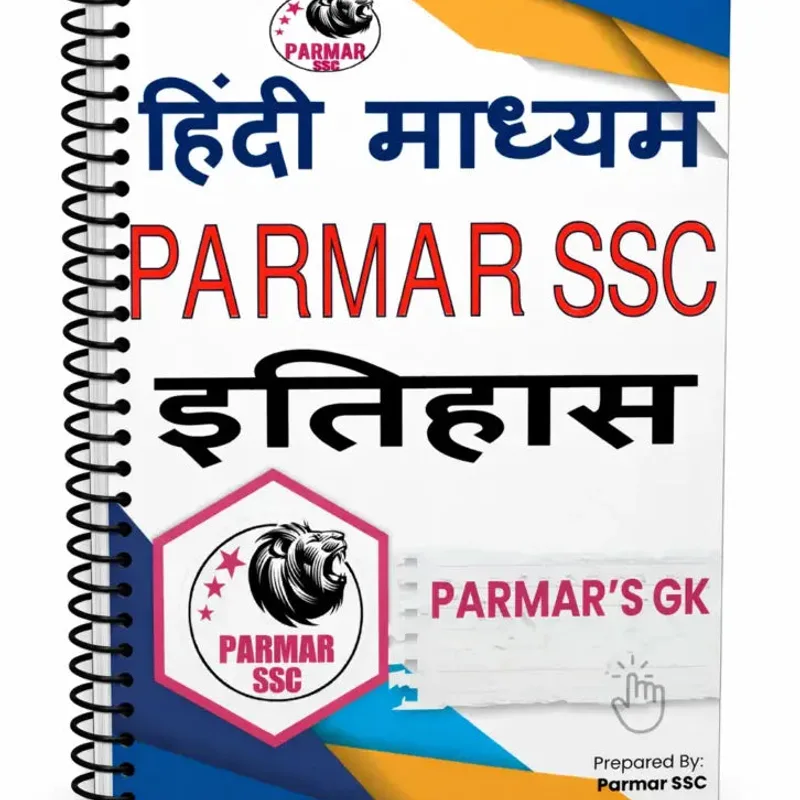
Parmar SSC GK History 4.0 | English Notes | Comprehensive UPSC & SSC Study Material | Premium Printed Edition
Product Overview
| Feature | Specification Details |
|---|---|
| Booklets Count | 3 High-Density Comprehensive Volumes (Ancient, Medieval, Modern) |
| Language | English (Academic Professional Grade) |
| Publisher | Parmar SSC Authorized Publications |
| Condition | Brand New (Latest 4.0 Revision) |
| Format | Premium Printed Spiral-Bound / Softcover High-Grip Edition |
| Paper Quality | 75 GSM Ultra-White Anti-Glare Paper |
| Ink Specification | High-Definition Laser Print (Smudge-Proof) |
Complete Booklet Catalog
The Parmar SSC GK History 4.0 English Medium set is meticulously organized into three distinct volumes, ensuring a modular approach to history that accommodates both the breadth of the UPSC syllabus and the precision required for SSC CGL/CHSL examinations. Each volume is indexed for rapid retrieval of specific historical eras.
- Volume I: Ancient Indian History 4.0 - Focusing on the foundational civilizations, archaeological evidences, and the evolution of social and political structures from the Stone Age to the Post-Gupta period.
- Volume II: Medieval Indian History 4.0 - A granular deep dive into the Sultanate eras, the Mughal Empire, administrative innovations, and the socio-religious movements that shaped the subcontinent.
- Volume III: Modern Indian History & Indian National Movement 4.0 - An exhaustive account of European advent, British consolidation, the 1857 revolt, and the complex journey towards Indian Independence including Constitutional developments.
Physical Product Specifications & Material Ergonomics
The Parmar SSC History 4.0 notes are not merely photocopies; they are engineered study materials designed for long-term durability and intensive revision cycles. We understand that a serious aspirant spends 8-10 hours a day with these materials, and the physical build reflects that necessity.
75 GSM Premium Paper
Unlike standard 50 or 60 GSM paper found in generic market notes, these booklets utilize 75 GSM ultra-white paper. This choice serves two functional purposes: first, it prevents "ghosting" or ink bleed-through when using highlighters or gel pens for personal annotations; second, it provides a tactile stiffness that prevents pages from dog-earing or tearing during rapid page-flipping.
Anti-Glare Matte Finish Ink
The printing process utilizes high-definition laser technology with a matte finish. This ensures that even under direct LED study lamps, the text does not reflect light into the reader's eyes, significantly reducing ocular fatigue during extended night-time study sessions. The carbon-black ink is chemically bonded to the fibers, making it resistant to moisture and accidental smudging.
Reinforced Binding Architecture
The notes are bound using industrial-grade spiral coils or high-tensile adhesive binding (depending on the specific batch). The spiral variant allows the booklet to lie perfectly flat (180 degrees) on a desk, which is essential for hands-free reading and taking side-notes in the margins. The covers are protected by a 300 GSM laminated cardstock that acts as a moisture barrier.
Deep Dive: Volume I - Ancient Indian History 4.0
Volume I is the cornerstone of the History 4.0 series. It is structured to transform a chronological narrative into a data-driven study guide. The booklet begins with an "Evolutionary Index," which maps the development of human civilization within the Indian subcontinent.
Internal Layout and Content Structure
The Ancient History booklet is divided into twelve primary chapters. Each chapter begins with a "Keywords and Concepts" box, ensuring the aspirant is familiar with Sanskrit and Pali terminology before diving into the text. This is a "Drishti-styled" feature that allows for quick vocabulary building.
Key Features within Ancient History:
- The Archaeological Site Map: Page 14 features a full-page, high-contrast map of the Indus Valley Civilization. Every major site (Harappa, Mohenjo-Daro, Lothal, Dholavira) is marked with specific symbols indicating what archaeological finds were discovered there (e.g., the Great Bath, the Dockyard).
- Vedic Comparative Tables: A dedicated section compares Early Vedic and Later Vedic periods across four parameters: Political Organization, Society, Religion, and Economy. This tabular format is optimized for "active recall" and eliminates the need for the student to create their own comparison charts.
- The Mahajanapada Matrix: A comprehensive index listing all 16 Mahajanapadas, their capitals, modern locations, and the significant rulers associated with them. This is formatted as a "Ready-Reckoner" for quick revision before Tier 1 exams.
- Buddhism and Jainism Special: These chapters include detailed charts on the Buddhist Councils (Venue, President, Patron, and Outcomes) and the Triratnas/Five Vows of Jainism. The formatting uses bold typography to highlight "Pillars" and "Edicts" of Ashoka.
Drishti-Vision Integration
Incorporated within the Ancient History volume are "Analytical Sidebars" that discuss the "why" behind historical shifts, such as the decline of the Mauryan Empire. These sidebars are written in a style that mimics UPSC-level analysis, providing a bridge between factual SSC data and conceptual UPSC understanding.
Deep Dive: Volume II - Medieval Indian History 4.0
The Medieval History booklet in the Parmar 4.0 series solves the biggest problem for aspirants: the overwhelming number of names, titles, and administrative terms. This volume is precisely 140 pages of densely packed, structured information that streamlines the transition from the Tripartite Struggle to the decline of the Mughals.
Chapter Breakdown and Indexing
The booklet follows a strict chronological order but separates "Political History" from "Administrative & Cultural History." This allows students to first understand the wars and successions, and then focus on the revenue systems (like the Mansabdari or Zabti systems) which are more complex.
Innovative Content Layouts:
- The Sultanate Chronology: A vertical timeline that tracks the Slave, Khalji, Tughlaq, Sayyid, and Lodi dynasties. Each page header contains a "Time-Tracker" so the student knows exactly which century they are studying.
- Mughal Administration Flowcharts: Instead of long paragraphs, the administrative structure under Akbar is explained via a hierarchy flowchart. From the Wazir to the Patwari, the roles are clearly defined in boxes.
- Bhakti and Sufi Movement Mapping: A unique geographic map showing the origin of various saints (Kabir, Nanak, Mirabai, Chaitanya) along with their philosophies (Dvaita, Advaita, Vishishtadvaita). This visual aid is crucial for Art & Culture questions that frequently appear in modern exams.
- The Architecture Appendix: At the end of Volume II, there is a 10-page dedicated appendix focusing solely on Indo-Islamic architecture, listing the features of different styles (Trabeate vs Arcuate) and the specific monuments built by various rulers.
Margin Space and "Officer's Notes"
Each page in the Medieval booklet leaves a 1.5-inch margin on the right side. This "White Space" is intentional, designed for students to add updates from Current Affairs or additional points from PYQs (Previous Year Questions). The bottom of every page includes a "Parmar's Pro-Tip" section—a small box containing a mnemonic to memorize lists like the order of Mughal Emperors or the five Sultanate dynasties.
Deep Dive: Volume III - Modern Indian History 4.0
Modern History is the most high-yielding section for any competitive exam. The Parmar 4.0 Modern History booklet is the most voluminous and detailed in the set. It focuses heavily on the period from 1757 to 1947, with an additional section on Post-Independence Consolidation (up to 1964).
Thematic Organization
The booklet is not just a story; it is a systematic breakdown of the British Impact on India. It categorizes the British rule into: Economic Impact, Educational Impact, Judicial Reforms, and Press Regulations.
Exclusive Modern History Content:
- The Governor-General & Viceroy Directory: A massive, 15-page tabulated section that lists every GG and Viceroy, the years of their tenure, and the major events/acts passed during their time. This is perhaps the most used section for SSC CGL prep.
- Revolt of 1857 Heatmap: A visual table listing the centers of the revolt (Lucknow, Jhansi, Kanpur, etc.), the Indian leaders, and the British officers who suppressed the movement.
- The INC Session Tracker: A chronological list of every Indian National Congress session from 1885 onwards, highlighting the President of the session and the significant resolutions passed (e.g., Swaraj resolution, Purna Swaraj declaration).
- The Constitutional Development Timeline: A rigorous breakdown of the Acts (1773 Regulating Act to 1947 Independence Act). Each Act is broken down into "Provision" and "Significance," making it easier to study for the Polity crossover questions.
Integration of Primary Sources
The 4.0 edition includes snippets from famous speeches and newspaper titles (e.g., Sambad Kaumudi, The Hitavada, Al-Hilal). This helps students associate historical figures with their literary contributions, a common pattern in the updated SSC syllabus.
Special "Drishti/Vision" Analytical Features
What sets the Parmar 4.0 series apart from traditional "one-liner" books is the inclusion of analytical depth usually reserved for UPSC-level material. Scattered throughout all three booklets are "Vision Boxes." These boxes do not just give facts; they explain the Cause-Effect Relationship of historical events.
For instance, in the Modern History booklet, a Vision Box explains how the American Civil War led to the cotton boom in India and subsequently influenced the Deccan Riots. This level of interconnectivity is what allows a student to answer "Statement-Based Questions" that are becoming increasingly common in SSC Tier 2 and State PCS exams.
Visual Aids and Information Design
The information density in these notes is high, but the readability is maintained through professional typography. The notes use a mix of Sans-serif fonts for headings and Serif fonts for body text to distinguish between "Main Ideas" and "Supporting Details." Bold text is used for names, dates, and locations, while italics are reserved for non-English terms and book titles.
- Bullet Points: Paragraphs are kept to a minimum. 90% of the content is in bulleted lists.
- Borders & Shading: Important formulas (in the context of historical math/land revenue) and definitions are enclosed in shaded boxes to draw the eye's attention.
- Navigation: Each page features a footer with the Chapter Name and Page Number, allowing for easy navigation while cross-referencing with video lectures.
Study Strategy for Parmar History 4.0
To get the maximum "Return on Investment" (ROI) from these notes, we recommend the 3-Step Parmar Approach:
- The First Pass: Read the booklet alongside the Parmar SSC YouTube or App lectures. Highlight the points emphasized in the videos using a yellow highlighter.
- The Mapping Pass: On the second reading, focus exclusively on the maps and tables. Try to visualize the Mahajanapadas or the expansion of the Mughal Empire on a blank map while referring to the booklet.
- The Revision Pass: Use the "Keywords" box at the start of each chapter and the "Summary Tables" at the end. At this stage, you should only be reading the bolded text and your personal margin notes.
Frequently Asked Questions (FAQ)
1. Are these notes sufficient for the UPSC Civil Services Examination?
While these notes are extremely detailed and cover the entire base of the UPSC syllabus (Ancient, Medieval, Modern), they are primarily optimized for objective and analytical prelims-style questions. For UPSC Mains, these serve as an excellent factual foundation, though students would still need to practice answer writing separately.
2. How does the 4.0 version differ from the previous 3.0 version?
The 4.0 version includes updated data from the latest archaeological findings (like Rakhigarhi updates), more comparative tables, improved paper quality, and a dedicated section on "Art & Culture" integrated within the historical periods. The layout has also been redesigned for better readability.
3. Is the language strictly English, or is it bilingual?
This specific product is the "English Notes" version. All text, indices, and explanations are in English. This is ideal for students who are preparing for exams in the English medium or who want to improve their academic vocabulary.
4. What is the shipping and handling process?
The booklets are packed in a multi-layered waterproof courier bag to prevent any damage during transit. We ship via premium courier partners to ensure tracking is available within 24-48 hours of order placement.
5. Can I use these notes if I am not a student of the Parmar SSC paid course?
Yes. While the notes are designed to complement the lectures, they are "Self-Explanatory." The structure is logical enough that any student with a basic understanding of history can use them as a standalone study resource.
6. Is Art and Culture covered in these booklets?
Yes, Art and Culture is not treated as a separate subject but is integrated chronologically. For example, Temple Architecture is covered within the Gupta and Chola sections of the Ancient/Medieval booklets, which is the most effective way to learn it.
7. Are the notes printed in color or black and white?
The notes are printed in high-contrast black and white (Grayscale). This is done to keep the product affordable for students and to ensure that the user's own colored highlighters stand out clearly on the page.
8. Do these notes include Previous Year Questions (PYQs)?
The notes include "Integration of PYQ Themes." While they do not list every question ever asked, the content is curated based on the frequency of topics appearing in SSC and UPSC exams over the last 10 years. Important years and facts are highlighted based on their probability of appearing in future exams.
9. How do I verify the authenticity of my Parmar SSC History 4.0 notes?
Original notes feature high-quality 75 GSM paper and clear, non-pixelated text. Unauthorized photocopies usually have 50 GSM paper, blurred text, and poor binding. Always purchase from authorized distributors to ensure you receive the latest 4.0 revision.
10. Can these notes be used for State PCS exams (like UPPCS, BPSC, RAS)?
Absolutely. The depth of the Modern History booklet and the factual accuracy of the Ancient/Medieval sections make these notes highly suitable for the General Studies papers of various State Public Service Commission exams.
11. How many total pages are in the 3-booklet set?
The total page count across the three volumes is approximately 450-500 pages of high-density content. This ensures a comprehensive coverage without the fluff found in 1000-page textbooks.
12. Is there a digital version included with the physical purchase?
This product listing is for the physical, printed version only. Physical notes are recommended by educators to reduce screen time and improve retention through tactile learning.