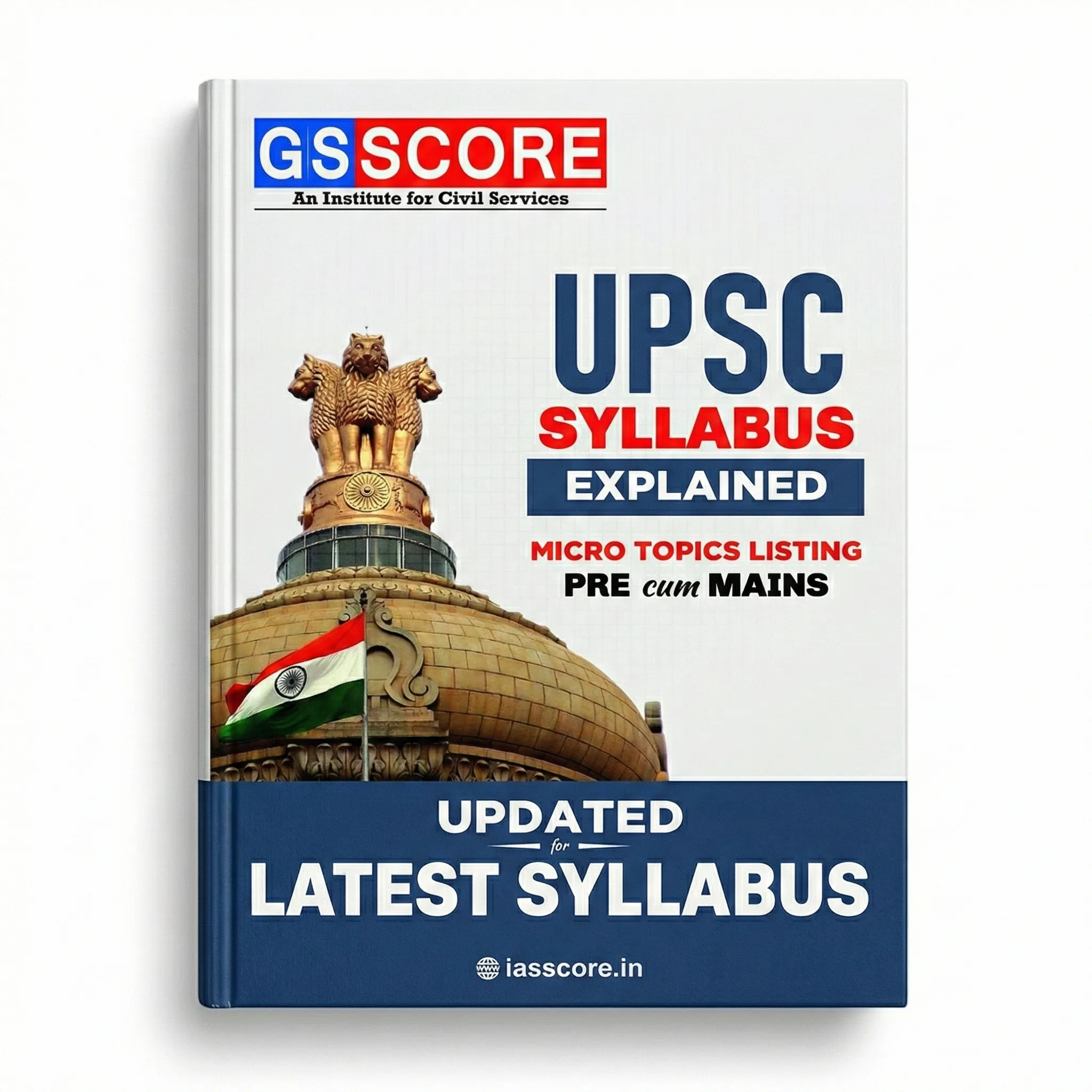

Ultimate Piyush Chaubey PSIR Notes | GS Score 2025-26 | Complete UPSC Study Material Set
Product Overview
| Feature | Specification Details |
|---|---|
| Booklets Count | Full Set of 10 Comprehensive Booklets (Covers Paper I & Paper II) |
| Language | English (Standard Academic Terminology for UPSC) |
| Publisher/Source | GS Score - Specialized Piyush Chaubey Faculty Edition |
| Condition | Brand New - Latest 2025-26 Revised Edition |
| Format | High-Quality Printed Booklets (Laser Print) |
| Binding | Heavy-duty Spiral Binding / Reinforced Softcover Wrap |
| Paper Quality | 75 GSM Ultra-White Paper with Anti-Glare Coating |
Complete Booklet Catalog
This premium study bundle is meticulously divided into 10 distinct volumes to ensure thematic clarity and ease of handling during intensive study sessions. The catalog below outlines the physical organization of the content:
- Booklet 1: Political Theory: Meaning, Approaches, and Perspectives on Justice, Equality, and Rights.
- Booklet 2: Western Political Thought: From Ancient Greek Philosophy to Modern Political Thinkers (Plato to Marx).
- Booklet 3: Indian Political Thought: Ancient, Medieval, and Modern Perspectives (Dharamshastra to Ambedkar).
- Booklet 4: Political Ideologies: Liberalism, Socialism, Marxism, Fascism, Gandhism, and Feminism.
- Booklet 5: Indian Government and Politics (Part A): Constitutional Framework, Preamble, and Fundamental Rights.
- Booklet 6: Indian Government and Politics (Part B): Federalism, Grassroots Democracy, and Statutory Bodies.
- Booklet 7: Comparative Politics: State Theories, Political Economy, and Global Perspectives.
- Booklet 8: International Relations (Part A): Core Theories, Key Concepts, and Global Institutions.
- Booklet 9: India and the World (Part A): Evolution of Foreign Policy, Bilateral Relations with Major Powers.
- Booklet 10: India and the World (Part B): India and Neighborhood, Regional Blocks, and Emerging Global Issues.
In-Depth Content Analysis: Paper I (Political Theory and Indian Politics)
The Piyush Chaubey PSIR Notes are globally recognized among UPSC aspirants for their structured approach to complex theories. Below is a deep dive into the internal mapping of Booklets 1 through 6.
Booklet 1 & 2: The Foundation of Political Philosophy
Booklet 1 focuses on the conceptual clarity of political science. Each page is printed with high-resolution laser ink to ensure that the complex diagrams representing "Power" and "Legitimacy" are crystal clear. The internal index lists chapters on Justice (Rawls vs. Nozick), where the notes use comparative tables to distinguish between liberal and egalitarian perspectives. The "Drishti/Vision Special" feature included in these booklets provides a quick summary of contemporary scholars like Amartya Sen and Martha Nussbaum to add value to your mains answers.
Booklet 2 transitions into Western Political Thought. This volume is physically substantial, containing over 250 pages of dense, structured content. Each thinker, such as Aristotle or Machiavelli, begins with a "Thinker Profile" box. The notes utilize a "Context-Text-Legacy" structure. For instance, the section on Thomas Hobbes includes a flowchart showing the transition from the "State of Nature" to the "Social Contract." The printing ensures that even the smallest footnotes regarding The Leviathan are legible under study lamps.
Booklet 3 & 4: Indian Thinkers and Ideologies
Booklet 3 bridges the gap between ancient traditions and modern Indian political consciousness. It contains a specialized index on Kautilya’s Arthashastra and the Saptanga Theory. The physical layout includes wide margins for students to add their own current affairs updates or personal mnemonics. The section on B.R. Ambedkar is particularly detailed, featuring internal sub-headings on the "Annihilation of Caste" and its relevance to modern constitutionalism.
Booklet 4 covers Political Ideologies. The GS Score editorial team has formatted this booklet with "Comparative Matrix" boxes. For example, the differences between Classical Liberalism and Neo-Liberalism are presented in a two-column table. The 75 GSM paper ensures that highlighters do not bleed through, allowing you to mark key terms in the "Feminism" and "Ecologism" chapters without ruining the reverse side of the page.
Booklet 5 & 6: Indian Government and Politics (IGP)
These volumes are the core of GS Paper II and PSIR Paper I Part B. Booklet 5 features a comprehensive breakdown of the Preamble and Basic Structure Doctrine. The internal content is structured chronologically, citing every major Supreme Court case from Shankari Prasad to Kesavananda Bharati. The font size is a comfortable 11pt, reducing eye strain during long reading hours.
Booklet 6 delves into the mechanics of Indian Democracy. It includes detailed data charts on Caste in Indian Politics and Regionalism. A unique "Vision Special" section at the end of the booklet provides a curated list of recommendations from the 2nd Administrative Reforms Commission (ARC), which are essential for scoring high in the UPSC Mains. The binding is specially reinforced here, as this booklet is often the most frequently used reference for both Optional and General Studies papers.
Detailed Examination: Paper II (Comparative and International Politics)
International Relations is a dynamic subject, and Piyush Chaubey’s notes for 2025-26 have been updated with the latest geopolitical shifts. Booklets 7 through 10 focus on the global stage.
Booklet 7: Comparative Politics
This booklet is designed to simplify the most abstract part of the syllabus. It contains 15 chapters, including "Nature of the State in Developing Societies" and "Globalisation and the State." The internal content uses Bold Key Terms to help aspirants identify the core vocabulary required for IR. The diagrams for "Dependency Theory" and "Systems Analysis" are professionally drafted, ensuring they are not just sketches but reproducible exam-ready models.
Booklet 8: International Relations Theory
Booklet 8 is the theoretical backbone of Paper II. It covers Realism, Idealism, and Marxist approaches to global politics. The internal index includes a specific section on "Nuclear Proliferation" and "International Political Economy." Each chapter concludes with a "Perspective Box" containing quotes from famous scholars like Hans Morgenthau and Kenneth Waltz. The paper quality reflects the premium nature of the GS Score brand, featuring a smooth finish that facilitates fast page-turning.
Booklet 9 & 10: India’s Foreign Policy (The Dynamic Duo)
Booklet 9 covers the Evolution of India’s Foreign Policy. It includes a deep dive into the Non-Aligned Movement (NAM) and its contemporary relevance. The physical product includes color-coded maps (in grayscale high-contrast) showing India's strategic interest in the Indo-Pacific and the "String of Pearls" vs. "Necklace of Diamonds" theories. The internal content is updated to include the outcomes of recent G20 summits and Quad meetings.
Booklet 10 focuses on Bilateral and Regional Relations. It is perhaps the most data-intensive booklet in the set. It includes a "Regional Block Summary" for SAARC, ASEAN, and BRICS. Each bilateral relation (India-USA, India-China, etc.) is divided into: Historical Context, Strategic Cooperation, Points of Friction, and Way Forward. The "Drishti-style" analysis provided in these notes ensures that you have a balanced viewpoint, which is a prerequisite for the UPSC personality test as well.
Physical Attributes and Manufacturing Standards
When you purchase the "Piyush Chaubey PSIR Notes | GS Score 2025-26," you are investing in a physical product designed for the rigors of a 12-month study cycle. We do not compromise on the tactile experience of learning.
Paper Quality: The 75 GSM Standard
Unlike cheap photocopied materials found in local markets, these booklets use 75 GSM high-brightness paper. This thickness provides several benefits:
- No Ink Bleed: You can use heavy ink pens or liquid highlighters without the pigment seeping through to the other side.
- Anti-Glare Finish: The paper has a matte-white finish that does not reflect harsh overhead LED lights, protecting your eyes during 10-hour study marathons.
- Durability: The pages are resistant to yellowing and brittleness, ensuring the notes stay in pristine condition for multiple revision cycles and future reference.
Printing Technology: Sharp Laser Precision
Every page is printed using industrial-grade laser printers. This ensures that:
- Consistency: There are no faded lines, smudges, or "ghosting" effects.
- Diagram Clarity: The intricate flowcharts of "World Systems Theory" and maps of "Central Asian Pipelines" are rendered with sharp borders and distinct shading.
- Font Optimization: We use a customized serif font for the body text to maximize readability and a sans-serif font for headers to provide a clear visual hierarchy.
Binding and Portability
The set is available in two binding formats: High-tensile Spiral or Reinforced Softcover. The spiral binding allows the booklet to lay 100% flat on your desk, which is essential when you are taking side-notes in your register. The covers are made of 300 GSM laminated cardstock, protecting the internal pages from moisture, dust, and minor spills.
Detailed Internal Feature: The "Success Mapping" Index
Each of the 10 booklets begins with a "Success Mapping" Index. This is not a standard table of contents. It includes:
- Syllabus Correlation: Every chapter mentions which specific line of the UPSC syllabus it covers.
- PYQ Mapping: A small icon next to a topic indicates that a question was asked on this subject in previous years (e.g., 2018, 2022).
- Keyword Highlights: A list of 5-10 "Must-Use" academic keywords for each chapter is provided at the start, ensuring your vocabulary remains professional and "PSIR-specific."
Internal Booklet Aesthetics: A Visual Guide
The internal layout is designed by educational psychologists to enhance memory retention. The use of "White Space" is intentional, preventing the "wall of text" phenomenon that causes mental fatigue. Key concepts are often enclosed in lightly shaded grey boxes to signify their importance. Bulleted lists are used extensively for "Pros and Cons" sections, making it easier to memorize points for the exam. The footer of every page includes the Booklet Number and Page Number for easy cross-referencing between volumes.
Why Choose Piyush Chaubey GS Score Notes for 2025-26?
The 2025-26 edition is not just a reprint; it is a complete overhaul. With the changing pattern of the UPSC Civil Services Examination, there is a greater emphasis on "Applied PSIR." These notes reflect that shift. The internal content moves beyond static theory and incorporates "Case Studies"—for example, the impact of the Russia-Ukraine conflict on the Liberal World Order is a dedicated sub-section in Booklet 8. The "India-China" section in Booklet 10 includes the most recent border dynamics and economic decoupling strategies discussed by Piyush Chaubey in his specialized GS Score sessions.
The Value Proposition for UPSC Aspirants
Buying these notes is a strategic decision. To compile this information yourself, you would need to read over 20 standard textbooks, including O.P. Gauba, Andrew Heywood, Baylis & Smith, and V.P. Verma, plus daily editorials from The Hindu and Indian Express. This 10-booklet set condenses approximately 8,000 pages of raw academic material into a manageable, exam-oriented format of roughly 2,200 pages. It is the definitive "one-stop solution" for PSIR Optional.
Frequently Asked Questions (FAQ)
1. Are these notes handwritten or printed?
These are high-quality laser-printed notes. They are based on Piyush Chaubey’s classroom lectures and GS Score’s proprietary research material. They are NOT messy handwritten scans; they are professionally typeset for maximum readability.
2. Does this set cover the entire UPSC PSIR Syllabus?
Yes, the 10-booklet set provides 100% coverage of both Paper I and Paper II. This includes all theoretical portions, Indian Government and Politics, Comparative Politics, and International Relations.
3. Is the content updated for the 2025-2026 exam cycle?
Absolutely. This is the latest edition, which includes current affairs updates up to late 2024, ensuring you have the latest perspectives on international treaties, elections, and geopolitical shifts.
4. What is the paper quality used in these booklets?
We use premium 75 GSM ultra-white paper. This is significantly better than the standard 50-60 GSM paper used in most photocopy shops, offering better durability and a superior writing/highlighting experience.
5. How are the booklets packaged for shipping?
We use a multi-layer packaging system. The booklets are first shrink-wrapped to prevent moisture damage, then placed in a heavy-duty corrugated box with corner protectors to ensure they reach you without any bends or tears.
6. Can I use these notes for my General Studies (GS) papers?
Yes. There is a significant overlap. Booklet 5 and 6 are excellent for GS Paper II (Polity & Governance), and Booklets 8, 9, and 10 are highly beneficial for GS Paper II (International Relations).
7. Are the diagrams and maps clear enough to study from?
Yes, all diagrams, flowcharts, and maps are printed using high-contrast settings. Even the most intricate maps of the South China Sea or the Middle East are clear and easy to understand.
8. Do the notes include Previous Year Questions (PYQs)?
Yes, the notes are structured around the UPSC pattern. Key sections include mentions of the years when specific topics were tested, and model answer structures for several PYQs are integrated into the text.
9. Is the language easy to understand for beginners?
Piyush Chaubey is known for his ability to simplify complex jargon. While the notes maintain the academic rigor required for the UPSC, the explanations are lucid and structured logically for someone starting their optional preparation.
10. What is the return policy if the product is damaged during transit?
We offer a 100% replacement guarantee. If you receive a set with printing errors, missing pages, or significant transit damage, simply provide a photo/video within 24 hours of delivery, and we will ship a replacement at no extra cost.
11. Do these notes include current affairs like G20 and the BRICS expansion?
Yes, the latest 2025-26 edition specifically includes modules on the expanded BRICS+, India's G20 Presidency outcomes, and recent developments in the Middle East (IMEEC corridor).
12. How much does the entire set of 10 booklets weigh?
The complete set weighs approximately 4.5 to 5 kilograms, reflecting the comprehensive nature and high-quality paper used in the production.