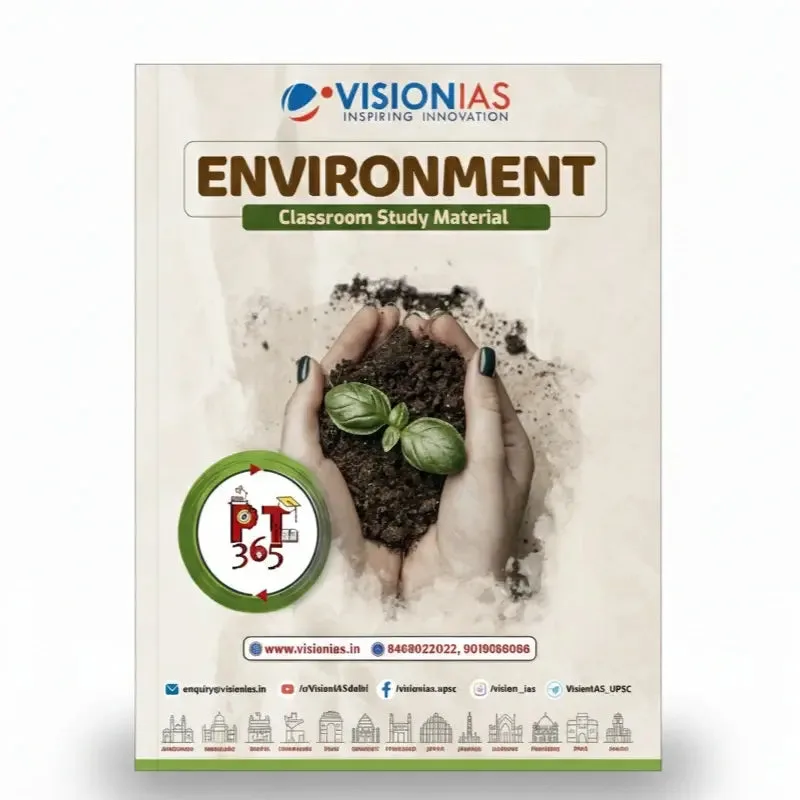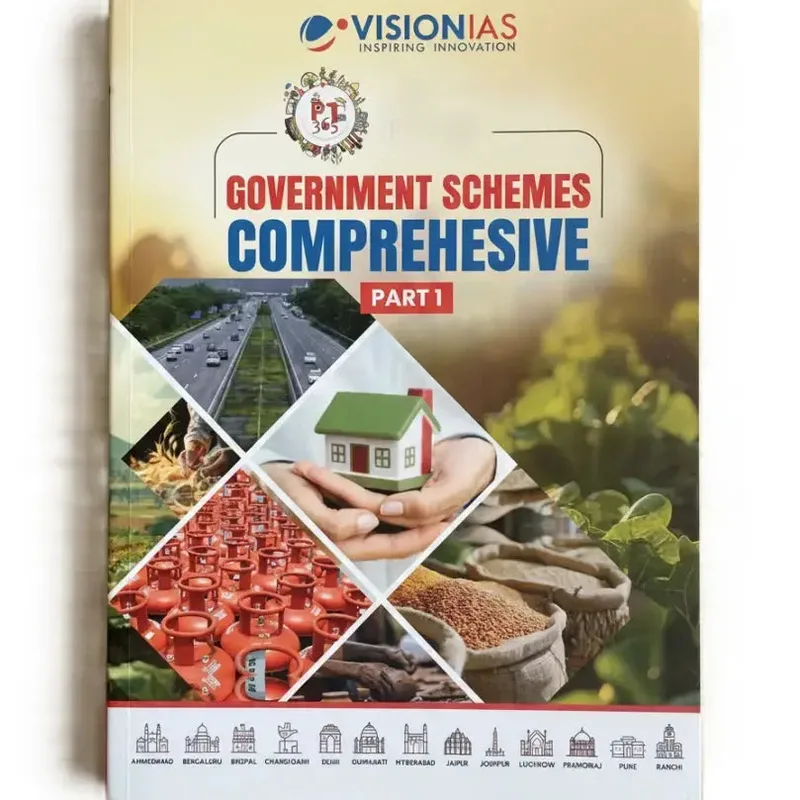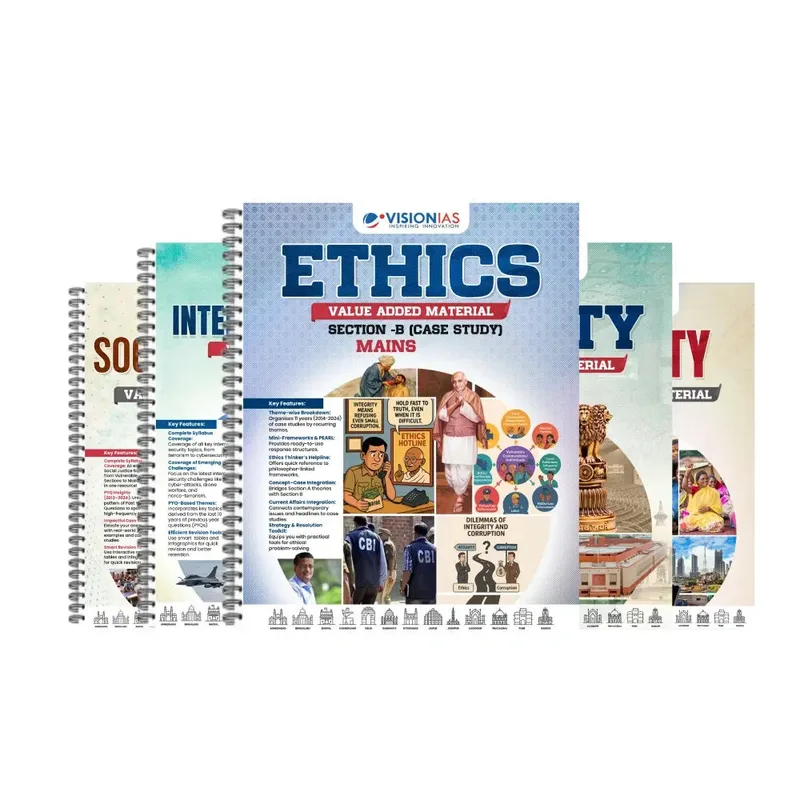
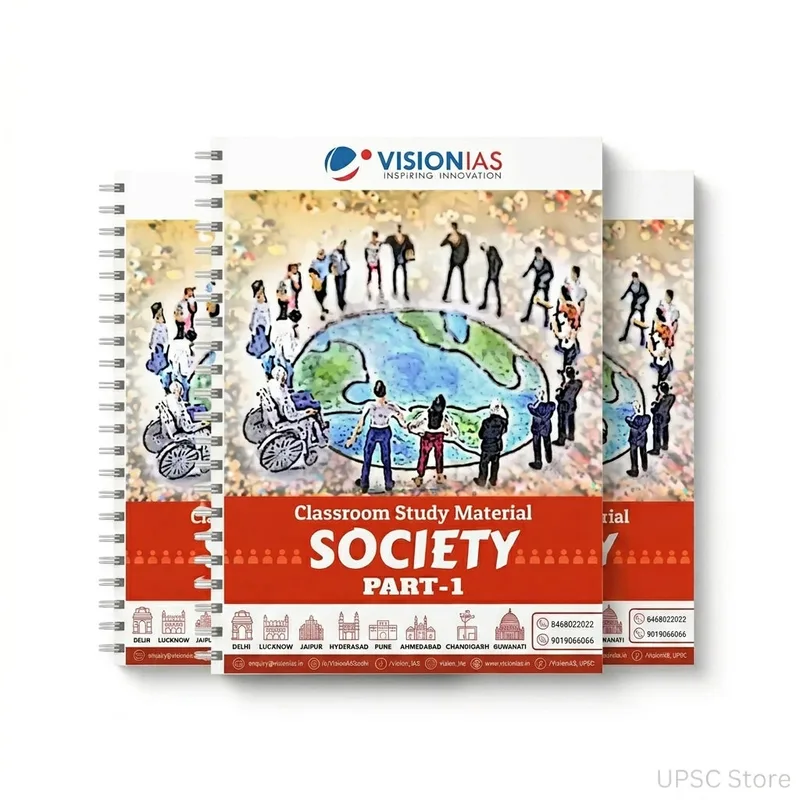
Vision IAS Indian Society English GS 2025 – 2026: Comprehensive Printed Booklet Set of 2 – The Ultimate Resource for UPSC Civil Services Mains
| Attribute | Specification Details |
|---|---|
| Booklets Count | Set of 2 Printed Booklets |
| Language | English Medium |
| Publisher | Vision IAS (New Delhi) |
| Condition | Brand New (Latest 2025-2026 Edition) |
| Format | High-Quality Printed Spiral/Perfect Bound Softcover |
Complete Booklet Catalog
This premium set consists of two distinct volumes, meticulously organized to cover the General Studies Paper I syllabus regarding Indian Society. Each booklet is designed with a specific thematic progression to ensure the aspirant transitions from foundational concepts to complex societal dynamics.
- Booklet 1: Foundations of Indian Society & Demographic Dynamics – Focuses on the structural components of Indian society, including the salient features, the diversity of India, the role of women, and the demographic profile including population and associated issues.
- Booklet 2: Social Issues, Challenges & Empowerment – Focuses on the problematic aspects and the transformative trends, including poverty, developmental issues, urbanization, globalization, and the critical triad of communalism, regionalism, and secularism.
Deep-Dive Analysis: Booklet 1 – Foundations and Demographics
The first volume of the Vision IAS Society Notes English GS 2025 – 2026 is a masterclass in structural organization. Upon opening the booklet, the reader is greeted by a high-resolution, multi-level table of contents. This index is not merely a list of pages but a roadmap of the UPSC syllabus. The booklet is partitioned into four major units, each containing sub-chapters that break down the societal fabric of India.
Chapter 1: Salient Features of Indian Society
This chapter serves as the introductory pillar. The printed text utilizes a clear, legible 11-point font that reduces eye strain during long study sessions. The content begins with the "Unity in Diversity" concept, presented through a series of structured bullet points. You will find dedicated sub-sections on the 'Caste System,' where the text describes its traditional varna-jati structure and its contemporary manifestations. The booklet uses 'Value Addition Boxes'—distinctly bordered areas—that provide sociological definitions from thinkers like M.N. Srinivas (Sanskritization, Westernization). The print quality ensures that the bolded terms for these concepts stand out sharply against the white 75 GSM paper.
Chapter 2: Diversity of India
In this section, the physical layout adopts a more categorical approach. The text is divided into Religious Diversity, Linguistic Diversity, Racial Diversity, and Caste Diversity. Each sub-section is supplemented by data tables reflecting the latest 2025-2026 projections based on the most recent governmental surveys. The linguistic diversity section features a printed map outline (in grayscale) indicating the major language families in India. The ink used is high-density black, ensuring that even the smallest labels on the maps are perfectly readable without magnification.
Chapter 3: Role of Women and Women’s Organizations
This is one of the most comprehensive chapters in Booklet 1. It covers the historical evolution of women's status in India. The internal layout includes a chronological timeline of women's movements in India. Specific sections are dedicated to "Women’s Organizations," which are listed in a tabular format for quick revision. The physical margins on these pages are wide (approximately 1.5 inches), specifically designed for aspirants to add their own current affairs updates or personal mnemonic devices. The ink is smudge-proof, allowing the use of highlighters without the fear of the text bleeding or blurring.
Chapter 4: Population and Associated Issues
The final section of the first booklet transitions into the demographic realm. This part of the booklet is heavy on statistical data and graphical representations. It includes printed pie charts and bar graphs illustrating the demographic dividend of India, sex ratios, and literacy rates. The graphs are rendered with high contrast, making the transition between different data sets clear. The text covers the "National Population Policy" and "Family Planning" measures with a focus on 2025-2026 targets. The page count for this chapter alone exceeds 40 pages, reflecting the depth of the printed material provided by Vision IAS.
Deep-Dive Analysis: Booklet 2 – Social Issues & Empowerment
Booklet 2 shifts the focus from the "what" of Indian society to the "how" and the challenges faced by the modern nation. The physical construction of this booklet matches the first, ensuring a uniform look on your bookshelf. The internal content is more analytical, focusing on the GS Mains requirement for critical evaluation.
Chapter 1: Poverty and Developmental Issues
This chapter is a dense compilation of data and theoretical frameworks. It discusses the definitions of poverty, the various committees (Alagh, Lakdawala, Tendulkar, Rangarajan), and the latest Multidimensional Poverty Index (MPI) findings. The booklet uses a hierarchical layout, where "Types of Poverty" are listed as sub-headers followed by detailed explanatory paragraphs. The paper quality allows for frequent page-turning without the risk of tearing at the spiral or perfect binding points.
Chapter 2: Urbanization, Their Problems, and Their Remedies
Urbanization is treated with a specific focus on the "Urban Heat Island" effect, "Slums," and "Urban Sprawl." The booklet includes detailed case studies printed in italics to distinguish them from the main text. There are schematic diagrams showing the "Concentric Zone Model" and "Sector Model" of urban growth. These diagrams are printed with crisp line-work, ensuring that the labels are not lost in the shadows of the print. The "Remedies" section lists government schemes like AMRUT, Smart Cities Mission, and PMAY in a summarized, easy-to-read list format.
Chapter 3: Effects of Globalization on Indian Society
This chapter explores the impact of globalization on various facets of life—culture, food, family structure, and the economy. The Vision IAS content team has included a section on "Glocalization," which is a frequently asked topic in the UPSC. The printed text uses flowcharts to demonstrate the ripple effects of global trends on local Indian traditions. This visual aid is crucial for the 2025-2026 exam cycle, where integrative thinking is rewarded.
Chapter 4: Social Empowerment, Communalism, Regionalism, and Secularism
The final chapter is arguably the most critical for the GS 1 Society section. It handles sensitive topics with academic neutrality. The section on "Social Empowerment" covers the Scheduled Castes, Scheduled Tribes, OBCs, and Minorities. The "Communalism" and "Regionalism" sections analyze the causes and consequences with the help of structured headings. The "Secularism" section compares the Indian model of secularism with the Western model in a side-by-side comparison table. The print is dense yet organized, ensuring that every page is packed with examinable information without feeling cluttered.
Physical Quality and Engineering of the Product
A primary differentiator of the Vision IAS Society Notes English GS 2025 – 2026 is the sheer physical durability and reading comfort provided by the production process. These are not standard photocopies; they are high-fidelity printed reproductions designed for rigorous academic use.
Premium 75 GSM Paper
Each booklet is printed on 75 GSM (Grams per Square Meter) bright white paper. This specific grade of paper is chosen for its opacity and "no-bleed" characteristics. Whether you are using a gel pen, a ballpoint pen, or a vibrant neon highlighter, the ink stays on the surface of the page and does not seep through to the reverse side. This allows the aspirant to utilize both sides of every sheet effectively, keeping the volume of the booklets manageable while maximizing the content.
Anti-Glare Matte Ink Technology
The ink used is a high-grade black carbon toner that produces a matte finish. Unlike glossy inks that reflect overhead study lamps and cause eye fatigue, this anti-glare ink ensures that the text remains visible from multiple angles. This is particularly beneficial for students who spend 8-10 hours a day reading. The contrast ratio between the deep black text and the white paper is optimized for 20/20 legibility.
Reinforced Binding Options
The set comes in two primary binding styles, both engineered for heavy use. The Spiral Bound version uses a high-gauge plastic or metallic coil that allows the book to lay completely flat on a desk, which is ideal for note-taking. The Perfect Bound version uses a strong thermal adhesive and a laminated cardstock cover (approx. 250 GSM) that protects the internal pages from humidity and environmental wear. The covers are finished with a moisture-resistant coating to prevent stains from coffee spills or sweat.
Optimized Layout for Retention
The internal layout follows a "Z-pattern" reading flow. Important keywords are bolded, and crucial definitions are centered. The booklets utilize a "Negative Space Strategy" where the gutters (the space between the text and the binding) are wide enough so that no text is lost in the fold. This ensures that even the words near the spine are fully legible without having to pry the book open forcefully.
Internal Content Features: The "Vision Special" Elements
What makes these 2025-2026 booklets unique is the inclusion of specific pedagogical tools that Vision IAS is known for. These are integrated directly into the printed text of the Society modules.
The "Concept Cloud" Summaries
At the end of major sections, the booklets feature a "Concept Cloud"—a visual summary of the most important terms discussed. This is designed for rapid revision in the final weeks before the UPSC Mains exam. The printing of these clouds uses different font sizes to indicate the relative importance of the topics based on previous year question trends.
Integrated Previous Year Questions (PYQs)
Rather than having a separate booklet, the Vision IAS Society notes integrate relevant PYQs at the end of each chapter. For example, after the chapter on "Urbanization," you will find the questions asked in the 2018, 2020, and 2023 Mains exams. This allows the student to immediately correlate the printed theory with the actual exam pattern. The questions are printed in a distinct boxed format for easy identification.
Current Affairs "Static-Dynamic" Integration
Since this is the 2025-2026 edition, the booklets are updated with the latest social surveys, the 16th Finance Commission observations related to demographics, and the most recent Supreme Court judgments on social issues (like the Marriage Equality case or reservations updates). These are seamlessly woven into the static content, so the student doesn't have to refer to multiple sources.
Model Diagrams for Answer Writing
A unique feature of these booklets is the inclusion of "Model Diagrams." These are hand-drawn style (but professionally printed) diagrams that an aspirant can replicate in the exam. Examples include diagrams on the "Cycle of Poverty," "Factors of Social Change," and "The Secularism Balance." The simplicity of these printed diagrams is intentional, designed for reproduction under time pressure.
Frequently Asked Questions (FAQ)
1. Is this the most updated version for the 2025 and 2026 UPSC attempts?
Yes, this set is specifically curated for the 2025-2026 academic cycle. It includes the most recent data from the National Family Health Survey (NFHS-5 and NFHS-6 projections), the latest periodic labour force surveys, and contemporary social issues that have emerged in 2024. The content is tailored to meet the evolving standards of the UPSC General Studies Paper I.
2. How is the print quality compared to standard market photocopies?
The quality is significantly superior. Unlike standard photocopies that often have black streaks, faded text, or blurred diagrams, these are high-fidelity prints. We use 75 GSM paper and high-density ink to ensure that every word, diagram, and chart is sharp and clear. The physical durability is designed to last the entire 2-year preparation journey.
3. Are these booklets sufficient for the "Indian Society" section of GS Paper 1?
Absolutely. These two booklets cover the entire syllabus as defined by the UPSC, including Salient Features, Diversity, Role of Women, Population, Poverty, Urbanization, Globalization, Social Empowerment, Communalism, Regionalism, and Secularism. While students should always read newspapers for daily updates, these booklets provide the definitive static and analytical base required for the exam.
4. What is the binding type, and will the pages fall out?
The booklets are available in either reinforced spiral binding or high-quality perfect binding (thermal glue). Both methods are executed with professional-grade machinery to ensure that the pages remain securely attached even with frequent use and heavy handling. The spiral used is crack-resistant, and the perfect binding uses a flexible adhesive that prevents the spine from cracking.
5. Does the 75 GSM paper allow for the use of highlighters?
Yes, the 75 GSM paper is specifically chosen for its thickness and resistance to ink bleed-through. You can use standard fluorescent highlighters, markers, and various types of pens. The ink will not saturate the paper or show through on the opposite side, which is a common problem with cheaper 50-60 GSM paper found in local shops.
6. Is the language used in the booklets easy to understand for beginners?
Vision IAS is known for its "student-centric" language. The booklets avoid overly dense academic jargon where possible, explaining complex sociological concepts in a lucid manner that is appropriate for the UPSC exam. It is designed to be accessible to students from both social science and non-social science backgrounds (like Engineering or Medicine).
7. How are the booklets packaged for shipping to ensure they don't get damaged?
We use a multi-layered packaging approach. Each booklet is first shrink-wrapped to protect against moisture. They are then placed in a bubble-wrap sleeve to absorb shocks during transit. Finally, they are shipped in a heavy-duty corrugated box or a reinforced waterproof courier bag to ensure they arrive at your doorstep in pristine, "bookstore" condition.
8. Do these notes include practice questions or only theory?
They include both. While the bulk of the content is theoretical and analytical, each chapter concludes with a selection of "Practice Questions" and "Previous Year Questions." These are designed to help you transition from reading to answer writing immediately after completing a topic.
9. Are there any maps or visual aids included in the booklets?
Yes, the booklets are rich in visual aids. They include schematic diagrams, flowcharts, tables, and grayscale maps. These are essential for the "Society" section, as visual representation of data (like demographic distribution) is a key requirement for scoring high marks in the Mains exam.
10. Can I use these notes for my Sociology Optional subject as well?
While these notes are specifically designed for the General Studies Paper I (Society), they provide an excellent foundational base for the "Indian Society" portion (Paper II) of the Sociology Optional. However, for the Optional subject, you would eventually need more specialized sociological theories, which these GS-specific notes touch upon but do not exhaustively cover.
11. What is the total page count for the set of two booklets?
The total page count across both booklets is approximately 280 to 320 pages. This varies slightly depending on the specific print run and formatting updates, but it is calibrated to provide maximum information density without becoming an overwhelming volume of text.
The Significance of the 2025-2026 Edition
The Indian societal landscape is in a state of rapid flux. From the introduction of new criminal laws (Bharatiya Nyaya Sanhita) that impact social justice to the shifting patterns of internal migration post-pandemic, a 2023 or 2024 edition is no longer sufficient. The Vision IAS Society Notes English GS 2025 – 2026 edition addresses these gaps. It includes the latest discourse on the "Digital Divide," the impact of AI on social structures, and the updated status of various social welfare schemes. By investing in this specific printed set, the aspirant ensures they are not studying outdated data, which is a common pitfall in the UPSC preparation process. The booklets provide the most current "Value Addition" points that can give an answer the edge needed to move from an average score to a top-tier rank.
Final Physical Overview
When you hold these booklets, the first thing you will notice is the weight—a testament to the 75 GSM paper quality. The covers are printed in high-color resolution, featuring the iconic Vision IAS branding and the clear "2025-2026" designation. The edges of the paper are precision-cut, preventing the "dog-ear" effect. Inside, the page numbering is consistent, and the footer of every page contains the chapter name, making it easy to navigate the book even when you are flipping through it rapidly. This is not just a study material; it is a professional tool designed for the serious civil services aspirant.